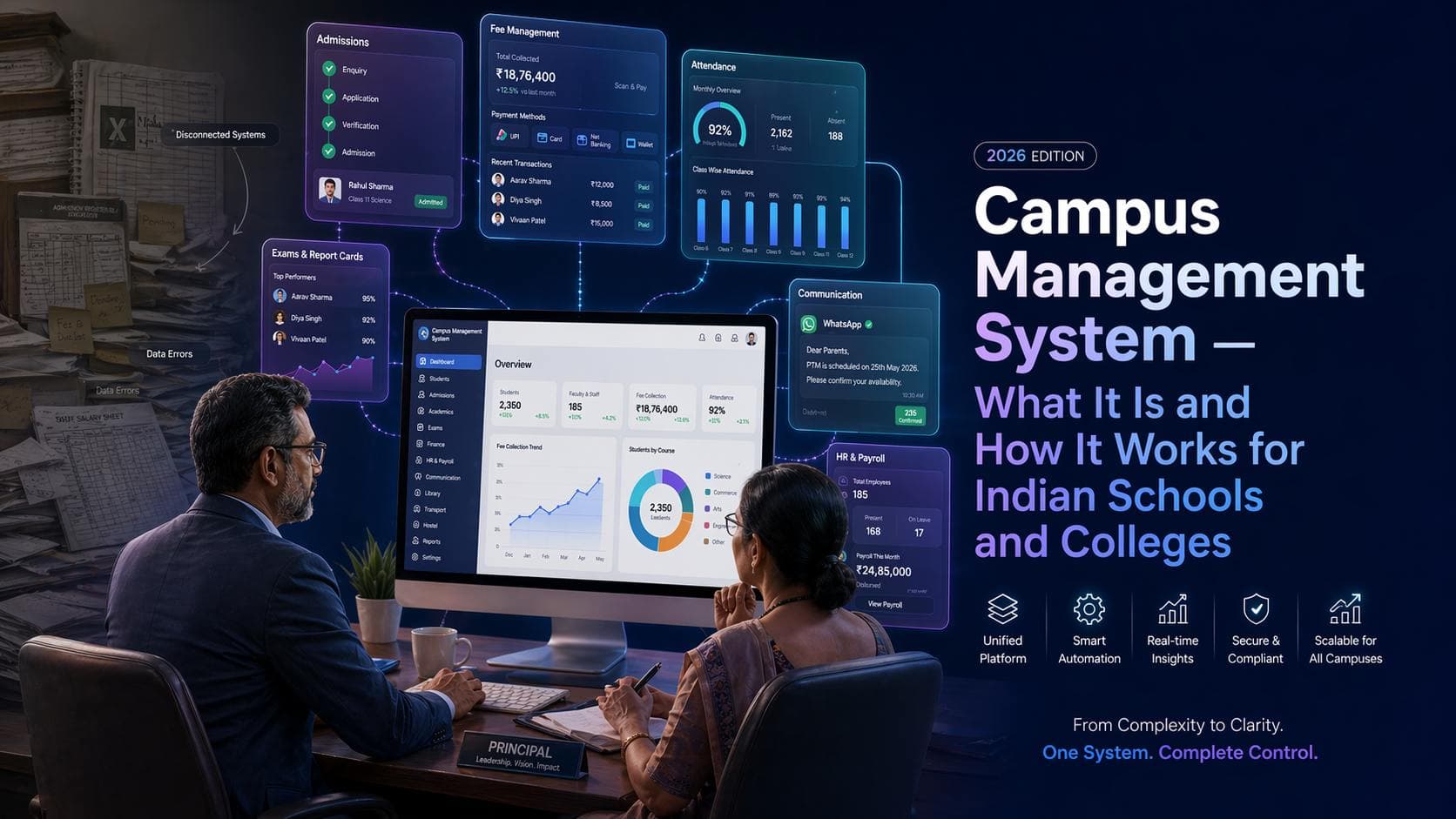
Campus Management System — What It Is and How It Works for Indian Schools and Colleges
A principal of a K-12 school in Pune and a registrar of a degree college in Jaipur have the same conversation every month-end. Attendance data is in one register. Fee records are in Excel. Exam results are with the academic coordinator. Parent communication goes through three different WhatsApp groups. HR and payroll sit with the accounts department. Nobody has a complete picture of the institution in one place — ever. A campus management system exists to solve exactly this — one platform, every operation, every stakeholder, every data point connected.
Whether you run a 300-student school or a 5,000-student college, the operational fragmentation problem is identical — and so is the solution.
What Is a Campus Management System?
A campus management system is an integrated software platform that manages all administrative, academic, and operational functions of an educational institution — school, college, or university — from a single interface.
The word "campus" is intentional. Unlike a basic administration tool that handles one or two functions, this category of software covers the full breadth of institutional operations:
Academic management: Admissions, attendance, timetables, examinations, results, and report cards.
Financial management: Fee collection, receipts, defaulter tracking, payroll, and budgeting.
Administrative management: Student records, staff records, document management, and HR.
Communication: Parent notifications, staff communication, circular management, and WhatsApp integration.
Infrastructure management: Transport, library, and hostel management for residential institutions. Pune's residential and boarding schools — from hill campuses to city day-boarding models — need hostel, transport, and fee modules in one school ERP software in Pune.
The defining characteristic is integration — data flows between modules automatically. The fee department knows who is academically active, the principal sees collection status in real time, and parents receive updates without manual triggers.
Campus Management System vs School ERP — Is There a Difference?
The terms are used interchangeably in India, and for practical purposes, they refer to the same category of software.
The subtle distinction: "School ERP" emphasises resource management — financial, human, and operational — borrowed from corporate ERP terminology. "Campus management system" emphasises institutional scope — the entire campus, from student lifecycle to staff management to infrastructure — and is used more often for institutions that include both school and college operations, or multi-campus setups.
In the Indian market, both terms describe the same solution. If you're evaluating one, you're evaluating the other. For a detailed breakdown, read our guide on what is school ERP software.
How a Campus Management System Works — The 5 Core Layers
The platform works as five layered systems where each layer serves a different operational function — and every layer shares data with every other.
Layer 1: Student Information Layer. Every student has a single digital profile — admission data, academic history, fee records, attendance, documents, communication log. When a student is promoted, their complete history moves automatically. For institutions on the Indian academic calendar (April–March), promotion happens during the May–June window.
Layer 2: Academic Management Layer. Timetable creation, attendance tracking, exam scheduling, marks entry, result processing, and report card generation — all connected. Attendance marked reflects in the student profile instantly. Results published trigger parent notifications without manual action.
Layer 3: Financial Management Layer. Fee structure configuration, automated fee generation, online and offline collection (including UPI), receipt management, defaulter tracking, and payroll. The system enforces fee-clearance policies — no hall ticket without fee clearance — automatically.
Layer 4: Communication Layer. WhatsApp Business API, push notifications, SMS, in-app messaging, circular management. An absent student in Layer 2 triggers a parent notification automatically. A fee due date in Layer 3 triggers a reminder. Institutions in tier-2 cities report this event-driven communication as the biggest time-saver. For a deeper look at how this works, see WhatsApp communication for schools.
Layer 5: Administration and Compliance Layer. Staff records, HR management, document storage, UDISE+ reporting, NAAC data management, NEP 2020 compliance tracking. Aggregates data from all layers to produce institutional reports and audit-ready records. Colleges preparing for accreditation should see how NAAC accreditation ERP software maps each criterion to structured ERP data.
Who Uses a Campus Management System — and How
Different users access the same platform with different interfaces and permissions:
Principal / Management: Dashboard view — fee collection, attendance rates, exam performance, staff status. Real-time visibility without requesting data.
Accounts Department: Fee collection, receipts, defaulter reports, payroll — all in one place.
Class Teachers: Attendance marking, marks entry, parent communication for their section. Role-restricted to only their students.
Students and Parents: Mobile app and self-service portal — fee payment via UPI, result viewing, attendance records. Institutions report this reduces front-desk calls by 40–60%.
Administrative Staff: Student records, admissions, TC generation, document management — searchable in seconds.
Same platform, different views — everyone sees what they need, nothing they don't.
Campus Management System for Schools vs Colleges — Key Differences
The core platform is the same. The configuration differs:
Schools:
- Class-teacher model — one teacher manages one section
- Term or annual exam system aligned to CBSE, ICSE, or state board
- Board-specific report cards (CBSE 5-point grading, ICSE percentage)
- Parent-heavy communication — daily attendance alerts, fee reminders
- Single-campus typically
Colleges:
- Department-wise structure with subject teachers across departments
- Semester system with internal assessments and university exams
- NAAC accreditation data requirements
- University affiliation coordination — hall tickets, result submission
- Multi-branch or affiliated college networks (for schools rather than colleges, see can one ERP run multiple school branches)
A well-designed system handles both through configuration — not separate products. Trusts running schools and colleges need one platform that scales from Class 1 to postgraduate without switching software.
For school-specific details, see school ERP software in India. For college-focused features, visit college and campus management system.
What to Look for in a Campus Management System for Indian Institutions
Five non-negotiables:
1. Cloud-based, mobile-first. Most Indian staff access software on phones, not desktops — especially in tier-2 and tier-3 cities. A system that isn't mobile-optimised will see low adoption regardless of features.
2. WhatsApp and UPI integration. These are India's communication and payment infrastructure. Parents expect attendance updates on WhatsApp and fee payment through UPI — not email or NEFT.
3. Indian board compliance. CBSE, ICSE, state boards — report cards, grading scales, and affiliation requirements are board-specific. Generic international software doesn't handle these natively.
4. NEP 2020 readiness. Holistic report cards, 5+3+3+4 structure, APAAR student IDs — any system purchased today must support NEP 2020 requirements as they roll out.
5. Integrated, not modular silos. The most common failure: buying separate software for fees, attendance, and exams that don't share data. The value is in the integration. Your fee management system must talk to your attendance management system without manual data transfer.
How Campus 24x7 Works as a Campus Management System
Campus 24x7 is built as a unified campus management system for Indian schools and colleges — not a collection of separate tools connected loosely.
Every module shares a single student database:
- Admission data flows into fee management automatically
- Attendance feeds into parent communication instantly
- Exam results trigger notifications without manual sending
- Fee defaulters are flagged in result processing automatically
Built specifically for Indian institutions: WhatsApp Business API integration, UPI payment support, CBSE and ICSE report card formats, NEP 2020 compliance features, and UDISE+ data export — all included, not add-ons.
Frequently Asked Questions
What is a campus management system in India and who needs one — schools, colleges, or both?
A campus management system India institutions adopt is a unified platform covering admissions, fees, attendance, exams, HR, library, hostel, and parent communication from one database. K-12 schools in Nagpur need class-section workflows; degree colleges in Bengaluru need department-semester models; multi-branch trusts need consolidated dashboards. If your institution runs more than two disconnected tools today — one for fees, another for attendance, WhatsApp for communication — you are already managing a fragmented campus that a single campus management software layer can replace.
How is campus management software different from standalone fee or attendance tools?
Standalone tools solve one problem but create data silos. Fee software does not know attendance; attendance software does not gate report cards. Campus management software shares one student ID across every module — when a Mumbai ICSE school marks a student absent, the parent alert, exam eligibility flag, and fee ledger all reference the same record. Reporting across departments takes minutes instead of compiling Excel from five coordinators every month.
What modules should a campus ERP system include for a multi-branch trust in India?
A practical campus ERP system for a trust running three schools and one college should cover admissions, fee management with UPI, attendance (biometric or app), exam and board report cards, staff HR and payroll with PF/ESI, parent communication via WhatsApp Business API, transport, library, and trust-level analytics. Each branch keeps its own fee structure and timetable while trust leadership sees enrolment, collection rates, and attendance trends across all campuses on one screen.
How much does a campus management system cost for a 500-student school in India?
Most cloud platforms price per student rather than flat enterprise rates. For a 500-student CBSE school, annual spend often falls between ₹40,000 and ₹80,000 depending on modules and support — far below hiring an additional admin clerk at ₹18,000–25,000 per month. Campus 24x7 uses per-student pricing with core modules bundled, which helps smaller campuses avoid the ₹3–5 lakh flat quotes common from legacy vendors.
See how Campus 24x7 works as your campus management system →
Explore the full campus management system solution page →