ERP for Small Schools India — You Don't Need 1,000 Students to Stop Managing on Excel
A school principal in Meerut runs a 220-student CBSE school with 2 admin staff and herself. She manages admissions, fee collection, attendance, and parent communication — across WhatsApp, Excel, a register, and a notebook that only she understands. She looked at school ERP software once. The demo was built for a 3,000-student institution. The pricing assumed a full admin team. She closed the tab. "Not for schools like mine," she concluded. She was wrong — but understandably so.
Most school ERP marketing targets large institutions. Small schools have the same operational problems — scaled down in volume, but not in complexity or the time they consume. ERP for small schools India isn't a scaled-down enterprise product — it's a different buying decision entirely.
Private schools with 150–400 students in Gorakhpur and Prayagraj are among the fastest adopters — same fee and report card pain as larger campuses, but with only two admin staff to carry the load.
Do Small Schools Actually Need ERP? (Honest Answer)
The honest answer: it depends on whether your current system is costing you more than an ERP would.
A school with 200 students has these operational realities every month. Fee collection from 200 families — tracking who paid, who hasn't, sending reminders, issuing receipts. Attendance for 200 students across 8–10 sections — compiling monthly reports, notifying parents of absences. Two to three exam cycles per year — collecting marks from 15–20 teachers, generating report cards. Parent communication — circulars, fee reminders, exam schedules, event notices.
At 200 students with 2 admin staff, these tasks consume 60–80 hours per month in manual work, schools report. That's nearly half of one person's working hours spent on tasks a system could handle in minutes.
The question isn't whether you're big enough to need ERP. It's whether the staff time you're spending on manual administration justifies the cost of automating it. For most small schools, the answer is yes — by a wide margin. For a detailed comparison of what changes when you move from spreadsheets to a system, see our post on school ERP vs Excel.
The 4 Reasons Small Schools Hesitate — Addressed Directly
Objection 1: "We can't afford it." Enterprise school ERP pricing — ₹2–5 lakhs per year for large institutions — is not relevant to a 200-student school. Modern cloud-based ERP for small schools typically costs ₹25,000–50,000 per year — less than the salary cost of the extra admin hours your current system consumes each month. Per-student pricing models mean you pay proportionally to your size. Our own school ERP plans and prices are published rather than quote-led, so you can check the per-student figure for your enrolment before booking anything.
Objection 2: "Our staff won't learn it." The assumption that ERP is complex comes from legacy software — on-premise systems with 200-screen workflows designed for IT professionals. Modern cloud-based small school management software is designed for school staff, not IT departments. If your staff can use WhatsApp, they can use a modern school ERP. Training for core functions takes one session of 2–3 hours.
Objection 3: "We don't have an IT team." You don't need one. Cloud-based means no server, no installation, no maintenance. The vendor manages the infrastructure. Your responsibility: log in and use it.
Objection 4: "We're too small to need it." Size isn't the variable — administrative complexity is. A 200-student school with active parent communication, online fee collection, and NEP-aligned report cards has the same software requirements as a 1,000-student school — just at smaller volume.
What Small Schools Actually Need from an ERP — and What They Don't
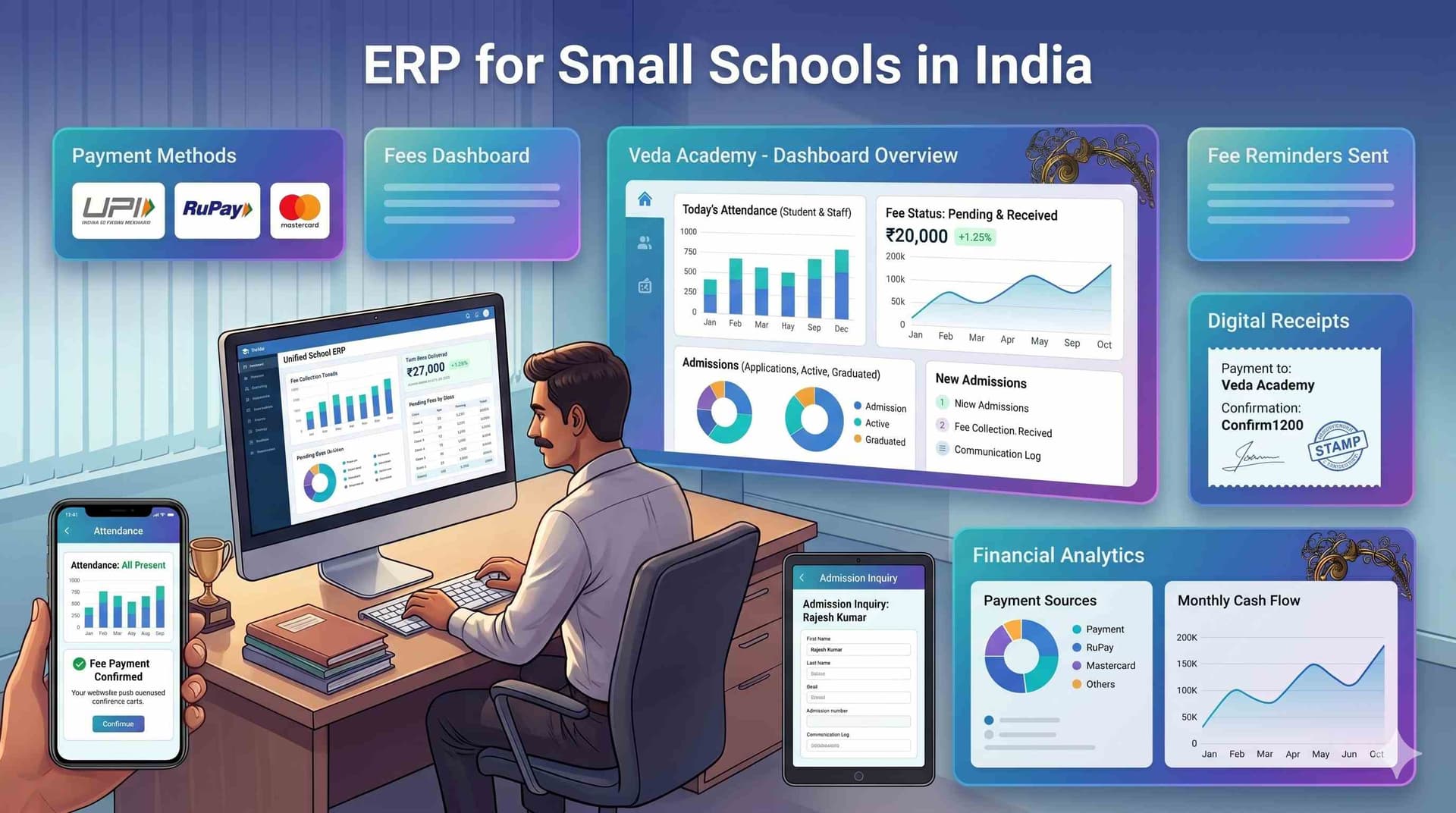
What small schools need: Student records and admissions management. Fee collection with online payment and automated reminders — a proper fee management system that handles UPI, cash, and cheque in one ledger. Attendance tracking with parent alerts — an attendance management system that works from a phone, not a biometric device. Exam marks and report card generation. Parent communication via WhatsApp, SMS, or app. Basic HR — staff attendance and payroll.
What small schools don't need immediately: Multi-branch management. Complex HR workflows for 200+ staff members. Advanced analytics dashboards. Custom API integrations.
The right ERP for a small school gives you everything in the first list without forcing you to pay for or navigate everything in the second. Module-based or tiered pricing — where you activate and pay for only what you use — is what to look for. Avoid vendors who bundle every module into every plan and charge enterprise rates regardless of size.
5 Areas Where ERP Saves Small Schools the Most Time
1. Fee collection and reminders. Automated reminders replace manual phone calls. Online payment replaces cash counter queues. Schools with 200 students report saving 15–20 staff hours per month on fee-related administration alone.
2. Report card generation. Marks entered by teachers digitally. Report cards generated in bulk — 200 report cards in under 5 minutes. No formatting in Word, no data entry errors.
3. Attendance tracking and parent alerts. Attendance marked on phone. Absent student's parent notified automatically. Monthly attendance report generated in one click.
4. Parent communication. One circular reaches all 200 families simultaneously — via app, SMS, or WhatsApp. No broadcast list management, no "who didn't receive it?" follow-up.
5. Admission management. Online application form replaces physical forms and manual data entry. Small schools typically save 3–5 days of admin time per admission cycle.
What to Look for in ERP for Small Schools
Four non-negotiables for small school ERP:
1. Per-student or tiered pricing — not a flat enterprise rate regardless of school size. If the vendor quotes the same price for 200 students and 2,000 students, the product isn't designed for you.
2. Cloud-based with no IT setup required — no server, no installation, no maintenance dependency on a vendor visit. You should be able to access the system from any browser or phone.
3. Essential modules included — fee, attendance, report cards, and parent communication in one plan — not sold as add-ons that double the cost.
4. Onboarding support included — not a self-service manual. A small school with 2 admin staff cannot afford to spend 2 weeks figuring out configuration independently.
How Campus 24x7 Is Built for Small Schools
Campus 24x7 is school ERP software in India designed from the ground up for schools that don't have a dedicated IT team or a large administrative department. The system runs on per-student pricing that scales with enrollment — a 200-student school pays for 200 students, not for infrastructure built for 2,000.
All essential modules are included — fee collection, attendance, report cards, parent communication, and basic HR. No nickel-and-diming on core features. The system is cloud-based and works on existing phones and laptops with no new hardware required.
The onboarding team sets up fee structure, student records, and the first attendance cycle — the school is live in under 2 weeks. Support is available 24/7 with a WhatsApp channel, so small school admin staff get answers when they need them, not after a 48-hour ticket queue.
Small schools joining Campus 24x7 early access get founding institution pricing — locked for life, not subject to future price increases.
Talk to Campus 24x7 about your school's specific needs →
Frequently Asked Questions
Is Campus 24x7 suitable for a school with fewer than 200 students?
Yes. Campus 24x7's per-student pricing means schools with 100 or even 80 students pay proportionally. The system's core modules — fee management, attendance, report cards, and parent communication — are the same regardless of school size.
How long does implementation take for a small school with limited admin staff?
Typically under 2 weeks. The Campus 24x7 onboarding team handles fee structure configuration, student data import, and initial setup. The school's admin staff need to invest approximately 2–3 hours in a training session to start using the system independently.
Can we start with just fee management and attendance and add modules later?
Yes. Schools can begin with the modules they need most urgently and activate additional modules as they're ready. There's no requirement to use every feature from day one.
What happens to our data if we outgrow the small school plan and need to upgrade?
All data carries forward. If a school grows from 200 to 800 students, the system scales with the enrollment — same platform, same data, adjusted pricing. There is no migration or re-implementation required.