15 Must-Have Features in School ERP Software (2026)
Indian schools are done with demo-only software. In 2026, the deciding factor is not how many modules a vendor lists, but which daily problems the system actually solves. A school ERP must shorten fee collection, remove attendance guesswork, and keep parents informed without manual follow-up.
This list is a tight, field-tested set of 15 features. If any are missing, you will feel the gap within one term. If all are present and integrated, your admin workload drops fast.
How this list was built
- Based on the highest-volume tasks in Indian schools.
- Prioritized features that reduce manual effort within 30 days.
- Included board compliance, payment realities, and parent communication habits in India.
1. Online fee collection with UPI
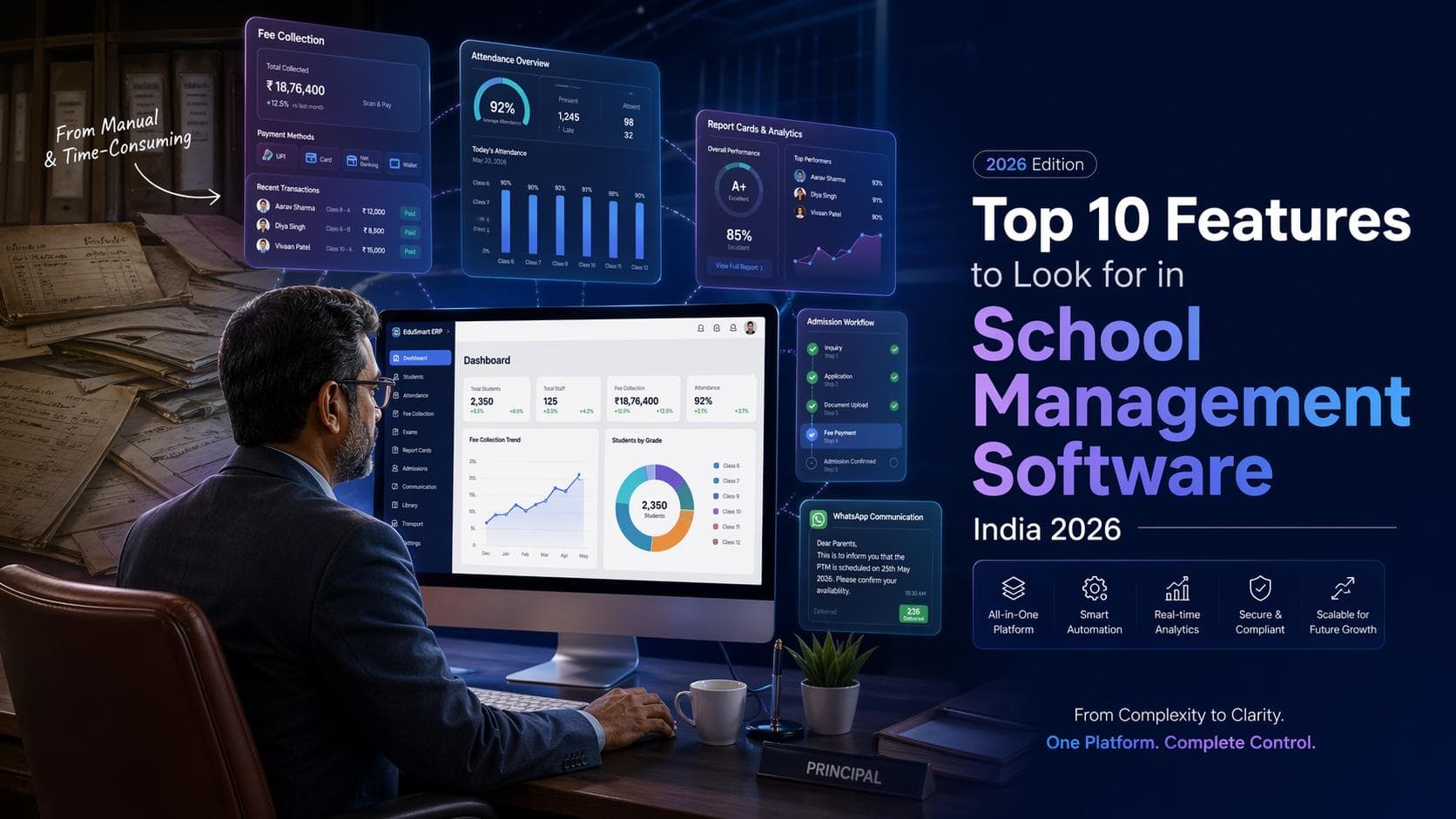
UPI is non-negotiable. Look for payment links, auto-receipts, late-fee rules, and defaulter dashboards. A robust fee management system should handle this without custom work.
2. Attendance with instant parent alerts
Parents should know absences within minutes. Digital marking plus SMS or WhatsApp alerts is the baseline. A well-built attendance management system removes daily follow-up calls.
3. Admissions with online forms
Admissions should accept online applications, documents, and fees. Manual forms and Excel lists will bottleneck the season.
4. Admission applications and documents
If applications arrive on paper and documents come over email and WhatsApp, the front desk cannot answer a status question without hunting. Look for online forms with documents attached to the application and a visible verification stage.
A separate question worth asking every vendor: does the system start at the enquiry or at the application? Many Indian school ERPs, Campus 24x7 included, handle applications but leave pre-application enquiry chasing to you. Neither answer is wrong, but find out before you assume.
5. Exam management and report cards
Teachers enter marks once, and the system calculates grades for CBSE, ICSE, and state boards. Bulk PDFs should generate in minutes.
6. WhatsApp Business API communication
School communication needs read receipts and accountability. Official WhatsApp messaging prevents confusion and keeps a clear audit trail. See how real-time WhatsApp communication for schools works with ERP-integrated triggers and delivery tracking.
7. Student information system (SIS)
A single student profile must carry admissions, fees, attendance, and documents. If data is split across modules, errors multiply.
8. Timetable and substitution
Timetables should be conflict-free and editable. Substitutions should be linked to leave and attendance data, not manual phone calls.
9. Transport management
Parents expect bus tracking and stop alerts. A transport management module should connect routes, fees, and notifications.
10. HR and payroll
Payroll should sync with attendance and leave. Visiting faculty, PF/ESI, and payslips must be handled without spreadsheets.
11. Library and inventory
Book issue tracking, fines, and quick searches save staff time. Inventory tracking is critical for labs and assets.
12. Dashboards and analytics
Principals should see fee collection, attendance trends, and exam performance without waiting for reports.
13. Compliance and exports
Support for CBSE/ICSE formats and UDISE+ exports reduces admin stress. NEP 2020 readiness is now a requirement, not a bonus. If you need NEP alignment, check NEP 2020 school ERP support early. For colleges, NAAC accreditation ERP software must generate structured data exports across all 7 criteria.
14. Data security and role-based access
Every action should be logged. Role-based access protects sensitive data and makes audits simple.
15. Mobile apps for parents and teachers
Teachers need quick attendance and homework tools. Parents need fees, circulars, and results in one place. Mobile-first matters more than desktop polish.
Quick evaluation checklist
- Can a parent pay fees and get a receipt in under 60 seconds?
- Can a teacher mark attendance in one tap per class?
- Are CBSE/ICSE report cards generated without manual formatting?
- Do WhatsApp alerts show delivery and read status?
- Is student data visible in one consolidated profile?
- Can the school export UDISE+ data without manual editing?
If you already use 3-4 features
You are likely seeing ROI already. The biggest jump in efficiency happens when fees, attendance, communication, and exams are fully connected. This is where data starts flowing without manual handoffs.
If you want a feature-by-feature demo, see how Campus 24x7 is built as school ERP software in India and request a walkthrough.
Frequently Asked Questions
Q1: Which feature should a small school prioritize first?
Start with fees and attendance. These two remove the most daily manual work and show ROI fastest.
Q2: Do all ERPs include WhatsApp integration?
Many claim it, but most use personal WhatsApp or the free Business app. Ask for official Business API integration with read receipts.
Q3: How many features are enough to justify an ERP?
Most schools see positive ROI once 3-4 core modules are adopted consistently. The full impact comes when modules share data.