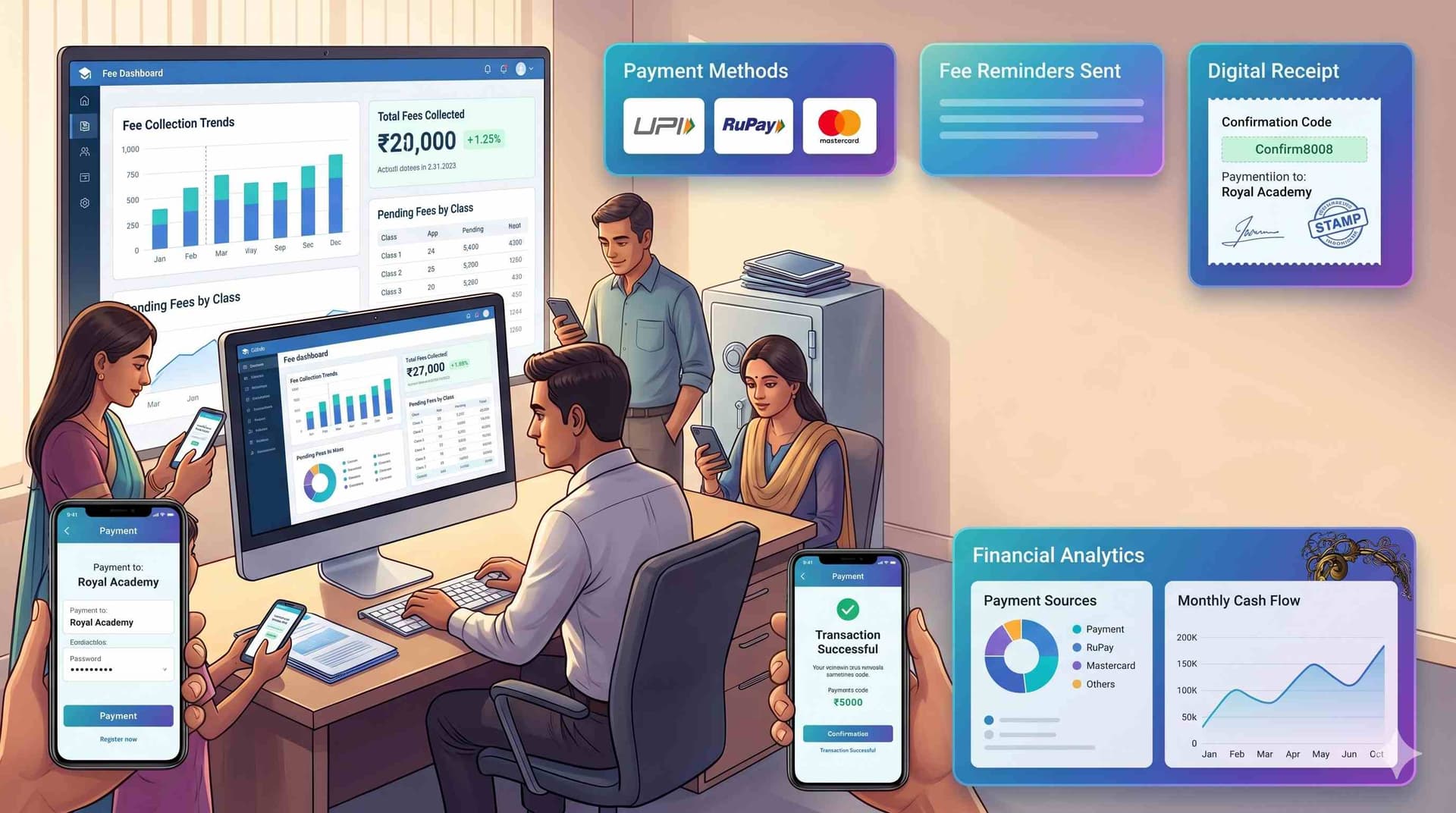
School Fee Collection Software India — Online, Automated, and Reconciled
It's the 16th of the month — the day after fee due date. The school accountant at a 600-student school in Nagpur has three stacks on her desk: cash to count, cheques to deposit, and a list of 140 students whose fees are still unconfirmed. Online payments came in through a payment link shared on WhatsApp — but matching those to specific students requires cross-referencing bank statements against a register manually. She'll spend the next two days on this. Every month. This is what school fee collection software India is built to eliminate.
Fee collection isn't the problem — reconciliation is. And reconciliation is only hard when collection isn't connected to student records from the start.
How Indian Schools Currently Collect Fees — The Full Messy Picture
Most Indian schools operate a hybrid fee collection model — not by design, but by accumulation:
Cash counter remains primary in many schools. Parent visits, pays cash, receives a handwritten receipt. Accountant counts cash daily, deposits in bank weekly.
Cheque collection: Cheques take 2–3 days to clear. Bounced cheques create manual follow-up. Receipt is often issued before clearance — a financial risk.
Bank transfer (NEFT/IMPS): Parents transfer directly. School receives no student identifier — just an amount. Manual matching against student records takes 30–40 minutes per day, schools report.
Standalone payment links (Razorpay, PayU): Post-COVID adoption. Collects money but doesn't know which student the payment belongs to unless the parent types details correctly — which they often don't.
The result: four parallel collection methods, four parallel reconciliation processes, no unified student fee ledger.
What Integrated Fee Collection Software Actually Does
For the full picture of the module rather than the collection step alone, see the school fee management system guide. Integration is the operative word. A school fee collection software not connected to student records and fee structures is just another payment tool adding to the reconciliation burden. What the term "online fee collection software school India" should actually mean is a system where payment and student record are the same transaction.
Fee generation happens automatically. Based on the configured fee structure, the system generates each student's fee demand — correct amount, correct due date, correct fee heads — at the start of every installment period. No manual challan creation. For how fee heads, installments, and discount rules are configured, see our guide on setting up fee structure in ERP.
Payment channels exist inside one system. Parent pays online via UPI, card, or net banking — payment is instantly matched to the student's fee ledger. For cash at the counter, staff records payment and a receipt is generated instantly. For cheques, details are recorded with clearance-pending status and updated when the bank confirms.
Reconciliation becomes automatic. Every payment, regardless of channel, lands in the same student fee ledger. Daily reconciliation report generated in one click — total collected, method-wise breakdown, pending collection, student-wise status.
Receipt management is built in. Every payment generates a numbered, dated, itemised receipt — sent to the parent via WhatsApp or email automatically.
Online Fee Collection — What Schools Get Wrong
Most schools that claim to "do online fee collection" are doing it incompletely.
Mistake 1: Payment link without student identification. A generic Razorpay link collects money — but the school doesn't know whose money it is until someone checks the bank statement and calls the parent. A proper school fee payment software links every transaction to a student record before payment is processed, not after.
Mistake 2: Online for tuition, cash for everything else. Transport fees, exam fees, activity fees still collected in cash separately. Parents visit school anyway. An effective digital fee collection system handles all fee heads through a single portal.
Mistake 3: No digital receipt. Payment processed, but receipt still issued as a paper slip — or not at all. Parents lose paper receipts. Schools face disputes about payments made months ago with no digital record.
Fee Collection Compliance — What Schools Are Now Required to Do
State education departments across India are increasingly mandating digital fee collection and receipt generation. Maharashtra, Karnataka, and Delhi have issued guidelines requiring schools to provide digital payment options and maintain digital fee records.
Schools in Gorakhpur and eastern UP are rapidly adopting online fee collection to replace manual registers — the same UPI and auto-reconciliation workflows that cut reconciliation time in metro schools.
CBSE affiliation norms reference financial management systems as part of institutional readiness evaluation. Schools applying for new affiliation or renewal are expected to demonstrate systematic fee management — not Excel sheets and paper registers.
Schools still running on cash and manual receipts face growing compliance risk. A school fee collection software that generates numbered digital receipts, maintains an audit-ready fee ledger, and produces GST-compliant reports positions the school for compliance without additional burden. For schools exploring comprehensive school ERP software in India, fee management is typically the first module that delivers measurable ROI.
Key Features of School Fee Collection Software
1. Student-linked online payment portal. Parents log in and pay against their child's exact fee demand — no manual identification needed.
2. Multi-channel collection. UPI, card, net banking, cash, and cheque — all recorded in the same ledger.
3. Automated receipt generation. Every payment triggers a numbered, itemised digital receipt sent via WhatsApp or email.
4. Real-time fee ledger per student. Complete payment history — paid, pending, overdue — in one view.
5. Daily reconciliation report. One-click report by channel, class, and fee head. Accounts head closes reconciliation in under 2 minutes, typically.
6. Automated payment reminders. Multi-stage reminders before and after due date with direct payment link. For reminder strategies and escalation workflows, see how schools reduce fee collection defaults.
7. Advance fee and wallet payments. Parents pay ahead — balance auto-deducted each installment.
8. Defaulter report with aging analysis. Sort defaulters by days overdue — 60-day defaulters and 3-day defaulters need different follow-up approaches.
What to Look for When Evaluating Fee Collection Software
Four questions to ask any vendor:
1. Is payment directly linked to student records — or does someone manually match payments afterward?
2. Does it support all payment methods Indian parents use — UPI, card, net banking, and cash at counter?
3. Does it generate numbered digital receipts automatically — not after manual entry?
4. Can the accounts head generate a reconciliation report in under 2 minutes — not compile it from multiple sources?
If any answer is "no," the software solves part of the problem and creates new ones elsewhere.
How Campus 24x7 Handles School Fee Collection
Campus 24x7's fee management system is built so that collection and reconciliation are a single workflow. The student-linked payment portal shows parents only their child's pending fees — no manual identification, no generic payment links.
All channels — UPI, card, net banking, cash, and cheque — feed into the same real-time fee ledger. Receipts are delivered via WhatsApp within seconds. The accounts head gets a one-click daily reconciliation report with method-wise and class-wise breakdowns.
For schools transitioning from manual collection, Campus 24x7 imports existing student data and maps prior payments so the ledger is accurate from day one. Based on early access feedback, schools typically reduce daily reconciliation time from 2–3 hours to under 10 minutes within the first month.
See Campus 24x7 fee collection in action →
Frequently Asked Questions
Can parents pay fees in installments through the online portal?
Yes. The fee structure defines installment schedules — monthly, quarterly, or custom — and the parent portal shows only the current installment due. The system tracks installment-wise payment status automatically.
What happens when an online payment fails midway — is the student marked as paid or unpaid?
The student remains unpaid until the payment gateway confirms success. If payment fails, the fee ledger is not updated. If money is debited but the gateway response is delayed, the system reconciles automatically within 24 hours based on settlement reports.
Does Campus 24x7 support UPI AutoPay for recurring fee collection?
Campus 24x7 supports UPI-based payments through its portal. UPI AutoPay for recurring mandates is on the product roadmap. Currently, parents receive reminder notifications with a direct payment link for each installment.
How does the system handle partial payments — where a parent pays some but not all of the fee due?
Partial payments are recorded against the student's fee ledger with the remaining balance shown as pending. The system does not mark the fee as paid until the complete amount is received. Reports distinguish between partially paid and fully paid students for targeted follow-up.