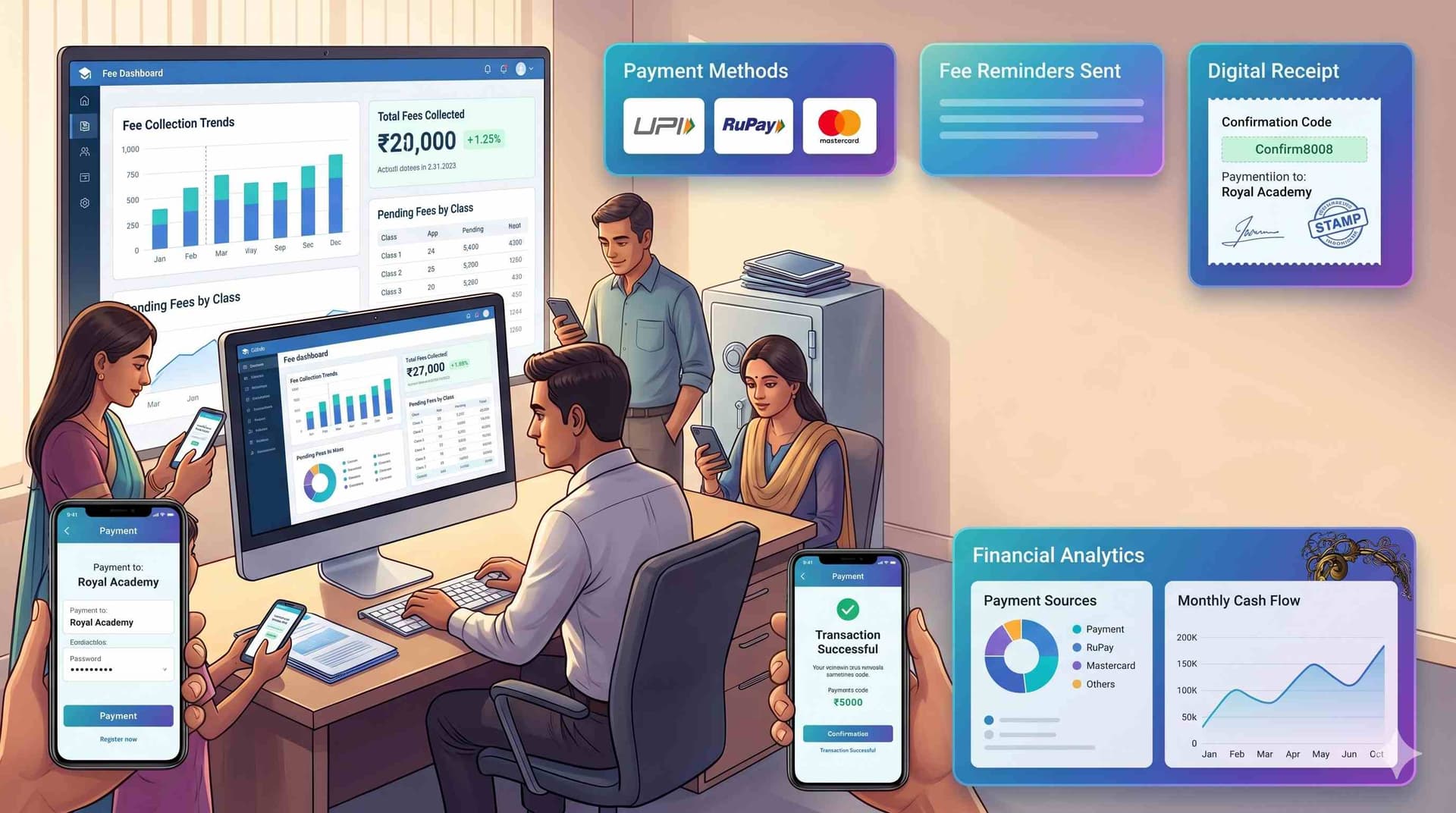
How to Reduce Fee Collection Delays in Schools (Proven Strategies)
It's the 15th of the month. Fee due date was the 10th. You still have ₹12 lakhs pending across 180 students. Your accountant has been making phone calls for 3 days straight. Some parents promise to pay "next week." Others don't answer. A few claim they already paid — but you can't find the receipt.
This scenario plays out in thousands of Indian schools every month. Fee collection delays aren't just an accounting problem — they're an operational crisis that affects salary payments, vendor commitments, and school development plans.
The good news: these delays are solvable. Schools that implement the right systems see 30-40% improvement in on-time collection within the first quarter. This guide shows you exactly how.
Why Fee Collection Delays Happen in Indian Schools
Before solving the problem, let's understand its root causes. Fee delays aren't primarily about parents being unable to pay — they're about friction, forgetfulness, and outdated processes.
Parents genuinely forget due dates
Between work, household responsibilities, and managing multiple children's school activities, fee due dates slip through the cracks. A parent intending to pay on the 8th gets busy and realizes on the 12th that they missed the deadline.
Unlike EMIs which auto-debit, school fees require active action. Without reminders, even willing parents miss deadlines.
Payment is inconvenient
Many schools still require parents to:
- Visit school during specific hours
- Stand in queues
- Carry cash or write cheques
- Get physical receipts
When paying fees requires 2-3 hours away from work, parents postpone it. They intend to pay "this weekend" — and weekend becomes next weekend.
No visibility leads to procrastination
When parents don't see clear fee breakdowns — what's due, what's paid, what's pending — they delay out of uncertainty. "I'll check with the school first" becomes an excuse for inaction.
Manual follow-up can't scale
An accountant can make 30-40 phone calls per day. With 200+ pending payments, effective follow-up is mathematically impossible. Schools end up chasing the same defaulters while missing others entirely.
No consequences for late payment
Many schools don't enforce late fees or don't communicate them clearly. When there's no cost to delaying, parents optimize for their convenience — even at the school's expense.
The Real Impact of Fee Collection Delays
Fee delays create cascading problems beyond just cash flow:
Staff salary stress
When ₹15 lakhs in fees is pending and salary date approaches, schools face impossible choices. Some delay salaries. Others take short-term loans at high interest. Teacher morale suffers either way.
Vendor relationships deteriorate
Uniform suppliers, bus contractors, lab equipment vendors — all wait for payment. Consistent delays damage relationships and sometimes result in service interruptions.
School development stalls
New computer lab? Playground upgrade? Smart classroom setup? All postponed because operating funds are tied up chasing pending fees.
Administrative burnout
Accountants spending 10-15 days per month on fee collection have no time for proper accounting. Financial reporting suffers. Audit preparation becomes stressful.
Parent relationships sour
Constant phone calls create resentment. Parents who received 5 calls for a 3-day delay feel harassed. Those who genuinely forgot feel embarrassed. Neither builds trust.
Proven Strategies to Reduce Fee Collection Delays
Here's what actually works — strategies implemented by schools across Delhi, Mumbai, Bangalore, Chennai, and tier-2 cities that have seen measurable improvement.
1. Implement automated reminder systems
The single highest-impact change you can make.
How it works:
- System sends SMS and app notifications automatically
- Reminders go out 7 days, 3 days, and 1 day before due date
- Each message includes exact amount and direct payment link
- Post-due reminders escalate appropriately
Why it works:
- Parents receive reminders when they can act (not just during office hours)
- No staff time required
- Consistent — every parent gets reminded, not just some
- Non-confrontational — a system message feels different from a phone call
Results: Schools report 20-30% improvement in on-time payment from automated reminders alone, before any other changes.
2. Enable online fee payment
When paying is as easy as ordering food online, parents pay faster.
Essential elements:
- UPI support (Google Pay, PhonePe, Paytm) — this is how most Indian parents prefer to pay
- Credit/debit card options
- Net banking for larger amounts
- Instant digital receipts
Implementation tips:
- Send payment links directly in reminder messages
- Make the payment flow 3 clicks or less
- Support partial payments if your fee structure allows
- Generate receipts automatically — no parent should have to request one
Results: Schools enabling online payments see 25-40% reduction in collection delays. The convenience factor compounds with automated reminders.
3. Create real-time visibility for parents
Parents who can see their fee status don't need to "check with the school."
What parents should access:
- Complete fee structure for the year
- Payment history with receipt downloads
- Current dues with breakdown
- Upcoming due dates
How to provide it:
- Parent mobile app (best experience)
- Parent portal on website (alternative)
- WhatsApp-based status queries (basic but works)
Results: Reduces "I didn't know" excuses. Parents planning to pay can verify amounts without calling school.
4. Implement and communicate late fee policies
Late fees aren't about punishment — they're about creating urgency.
Effective late fee structure:
- Grace period of 5-7 days (acknowledges genuine delays)
- Reasonable late fee (₹50-200, not punitive)
- Clear communication before due date
- Consistent enforcement — no exceptions
Communication is key: Send reminder saying "Pay by March 10 to avoid ₹100 late fee" rather than discovering late fee after the fact.
Results: Schools with enforced late fees see 15-20% better on-time payment. The key is consistency — if some parents get waivers, word spreads.
5. Use real-time defaulter dashboards
Stop waiting until month-end to know who hasn't paid.
What you need:
- Live view of paid vs pending by class/section
- Ability to filter and sort defaulters
- One-click access to parent contact information
- History of past payment patterns
How to use it:
- Check dashboard daily, not monthly
- Identify patterns (same parents late every month)
- Prioritize follow-up by amount and history
- Track follow-up actions
Results: Schools monitoring in real-time catch delays before they compound. A 3-day delay addressed immediately is easier to collect than a 30-day delay discovered at month-end.
6. Link fee status to critical school services
Create consequences beyond late fees.
Practical links:
- Exam hall tickets require fee clearance
- Report card access depends on fee status
- Event participation may be restricted
Important considerations:
- Communicate policies clearly at admission time
- Apply consistently across all students
- Have a process for genuine hardship cases
Results: When fees gate something parents value, payment priority increases. CBSE schools in Delhi and ICSE institutions in Mumbai commonly use exam hall ticket linking.
Manual Methods vs Fee Management System: A Comparison
| Aspect | Manual Process | Fee Management System |
|---|---|---|
| Reminders | Staff makes 30-40 calls/day | Automated SMS/app to all parents |
| Payment | Cash/cheque at office during hours | 24/7 online via UPI, cards |
| Receipts | Written by hand, duplicates lost | Instant digital, searchable |
| Defaulter list | Compiled manually, takes 1-2 days | Real-time dashboard |
| Follow-up tracking | Paper notes, often lost | Logged in system |
| Reconciliation | Manual matching, hours of work | Auto-matched |
| Parent queries | Check registers, call back | Parents check app themselves |
| Staff time | 50+ hours/month | 5-10 hours/month |
The difference isn't incremental — it's transformational. Schools switching from manual to automated fee management systems typically save 40-50 hours of staff time monthly while improving collection rates.
Building a Complete Fee Collection Strategy
Individual tactics help. A complete strategy transforms fee collection.
Phase 1: Foundation (Week 1-2)
Actions:
- Audit current fee collection process
- Document typical delay patterns
- Identify technology requirements
- Get staff buy-in for change
Outcome: Clear understanding of current state and roadmap for improvement.
Phase 2: Technology (Week 3-4)
Actions:
- Implement fee management system or configure existing ERP
- Set up payment gateway integration
- Configure automated reminders
- Test with pilot group of parents
Outcome: Technical infrastructure ready for scaled deployment.
Phase 3: Communication (Week 5)
Actions:
- Announce changes to all parents
- Provide app download/portal access instructions
- Share video tutorials for payment process
- Establish support channels for queries
Outcome: Parents understand new system and can use it confidently.
Phase 4: Launch and Monitor (Week 6+)
Actions:
- Go live with new system
- Monitor adoption and collection rates
- Address issues quickly
- Gather feedback and iterate
Outcome: Continuous improvement based on real data.
How Campus 24x7 Solves Fee Collection Delays
At Campus 24x7, we've built our fee management system specifically to solve collection delay problems in Indian schools.
Automated multi-channel reminders: SMS, app notifications, and email — configured once, running automatically. Parents receive reminders at 7, 3, and 1 day before due date with direct payment links.
Comprehensive online payment: UPI, cards, net banking — all major Indian payment methods supported. Parents pay from their phones in 30 seconds.
Real-time dashboards: See collection status instantly. Filter by class, section, or individual student. Export reports with one click.
Complete ERP integration: Fee management connects with admissions, attendance, examinations, and report cards. When a student is admitted, fee structure is auto-assigned. Report cards can require fee clearance.
Schools using our system report average 35% reduction in fee collection delays within the first quarter.
Frequently Asked Questions
How can Indian schools reduce fee collection delays without hiring more accounts staff?
The most effective approach combines school fee collection automation with channels parents already use. Automated WhatsApp and SMS reminders sent three days before, on, and after the due date reach every parent simultaneously — something no three-person accounts team in a Lucknow or Ahmedabad school can replicate by phone. Pair reminders with one-tap UPI payment links so parents pay at 10 PM without visiting the office. Schools using this model report 25–35% faster collection within the first quarter, based on early access partner feedback.
What does school fee collection automation actually include for a CBSE school in India?
Automation is more than an online payment gateway. For a typical 600-student CBSE school, it covers fee demand generation per installment, sibling and RTE discount rules, automated reminder sequences, UPI and card collection, instant numbered receipts on WhatsApp, real-time defaulter dashboards, and daily reconciliation reports for the accounts head. Campus 24x7 bundles these as one connected workflow in its fee management system — not separate tools that need manual syncing at month-end.
How does a fee reminder system for schools work with WhatsApp and UPI in India?
A proper fee reminder system for schools sends messages from the institution's verified WhatsApp Business API number — not a teacher's personal phone. Each reminder includes the student's name, amount due (e.g. ₹12,400 transport fee), due date, and a UPI payment link. When the parent pays via PhonePe or Google Pay, the ledger updates automatically and a receipt reaches WhatsApp within seconds. The principal sees delivery and read status for every message, ending the "I never got the reminder" disputes common in manual follow-up.
When is the best time of year to fix fee delays in Indian schools?
Start 4–6 weeks before your heaviest collection cycle — usually April (new session fees) or October (second installment) for most boards. Configure your fee structure and reminder rules during the quieter period, run one parallel collection cycle to validate amounts, then go fully live before the rush. Schools that wait until 40% of parents are already late spend the whole term recovering instead of preventing delays. Summer break (May–June) is ideal for setup if your academic year starts in July.
Conclusion
Fee collection delays aren't inevitable. They're a symptom of outdated processes that modern technology can solve.
The schools seeing the best results combine:
- Automated reminders that ensure every parent is notified
- Online payment options that remove friction
- Real-time visibility that enables proactive management
- Consistent policies that create urgency
The ROI is clear: reduced staff time, improved cash flow, better vendor relationships, and happier parents who aren't receiving constant collection calls.
If you're ready to transform fee collection at your school, explore our fee management system or request a personalized demo to see how it works with your specific fee structure.
For a complete overview of what school management software can do for your institution, explore our school management software or read our guide to choosing the right ERP system.