SCHOOL ERP SOFTWARE IN CHENNAI

School ERP software for Chennai schools running two boards at once

A Chennai campus often closes the same term against a Tamil Nadu State Board pattern and a CBSE one, for parents who read Tamil first and children who travel in from Tambaram, Porur and OMR. Campus 24x7 lets you configure both marking patterns in one account, reaches parents on WhatsApp in Tamil, Hindi or English from your school's own number, and marks the register on a phone at the classroom door.

Tamil Nadu State Board and CBSE patternsTamil, Hindi and English parent alertsFirst two months free
The Chennai reality

What actually breaks in a Chennai school office

Not hypotheticals — the five things principals and front-office staff here describe when a term is closing and half the parent base reads Tamil.

01

Two boards, two marking patterns, one term-end

Chennai is the most evenly split metro on this list: a deep Tamil Nadu State Board base alongside a large and growing CBSE sector, and plenty of trusts running both under one management. Each pattern wants its own weightage and its own pass mark, so every term-end turns into two parallel spreadsheet exercises done by hand.
02

Parents who read Tamil and staff who write English

The office drafts a notice in English. A good share of the parent base reads Tamil first. What goes out is either English that gets half-read, or a hurried translation typed into a WhatsApp group by whoever is free — with no record of who actually received it.

03

A commute that decides when the school day starts

Buses leaving OMR, Tambaram, Porur and Velachery sit in traffic that does not negotiate. First period goes on phone calls about who is still on the road, and attendance gets marked late — which means the absence that mattered is noticed at lunch instead of at 8am.

04

Fee follow-up that runs on a handwritten list

Front office prints the pending list, divides it between whoever is free, and calls down it. The list is stale by afternoon, two parents get called twice, and nobody can say later what was promised on which call.

05

Branches that reconcile over email

A trust with campuses across the city closes each month by asking every branch to send its own Excel. The totals disagree, somebody rebuilds them, and management sees a reliable number about three weeks after it stopped being useful.

Two boards, one term-end

Configure each marking pattern once, not every term

A State Board annual pattern and a CBSE term pattern are different weightages, different pass marks and a different scale. Both are settings here, and both can sit in the same school.

Tamil Nadu State Board
Annual pattern, marks-led. Set the pass percentage, give each subject its theory and practical split, and leave the scale on percentage bands.
CBSE
Term pattern with internals. Give the term its weightage, add an internal component alongside theory, and switch the same school's scale to the 10-point CGPA if that is how you report.
  • Teachers enter theory, practical and internal marks for their own subjects only
  • Results compute into a card per student: subject marks, total, percentage, grade, rank in section and class, and attendance
  • Cards stay drafts until you publish; reopening hides them again and reopens marks entry
  • Three card templates — traditional, modern and cumulative — each downloadable as a PDF
  • Publishing can fire the exam-result WhatsApp message to every parent in one step

A grading scale you define

Example
GradePercentage rangePoints
A191 – 10010
A281 – 909
B171 – 808
B261 – 707
C151 – 606

An illustration, not a board-issued table. The bands, their minimum and maximum, the points and the colours are all yours to set — or switch the whole scale to percentage bands or grades only.

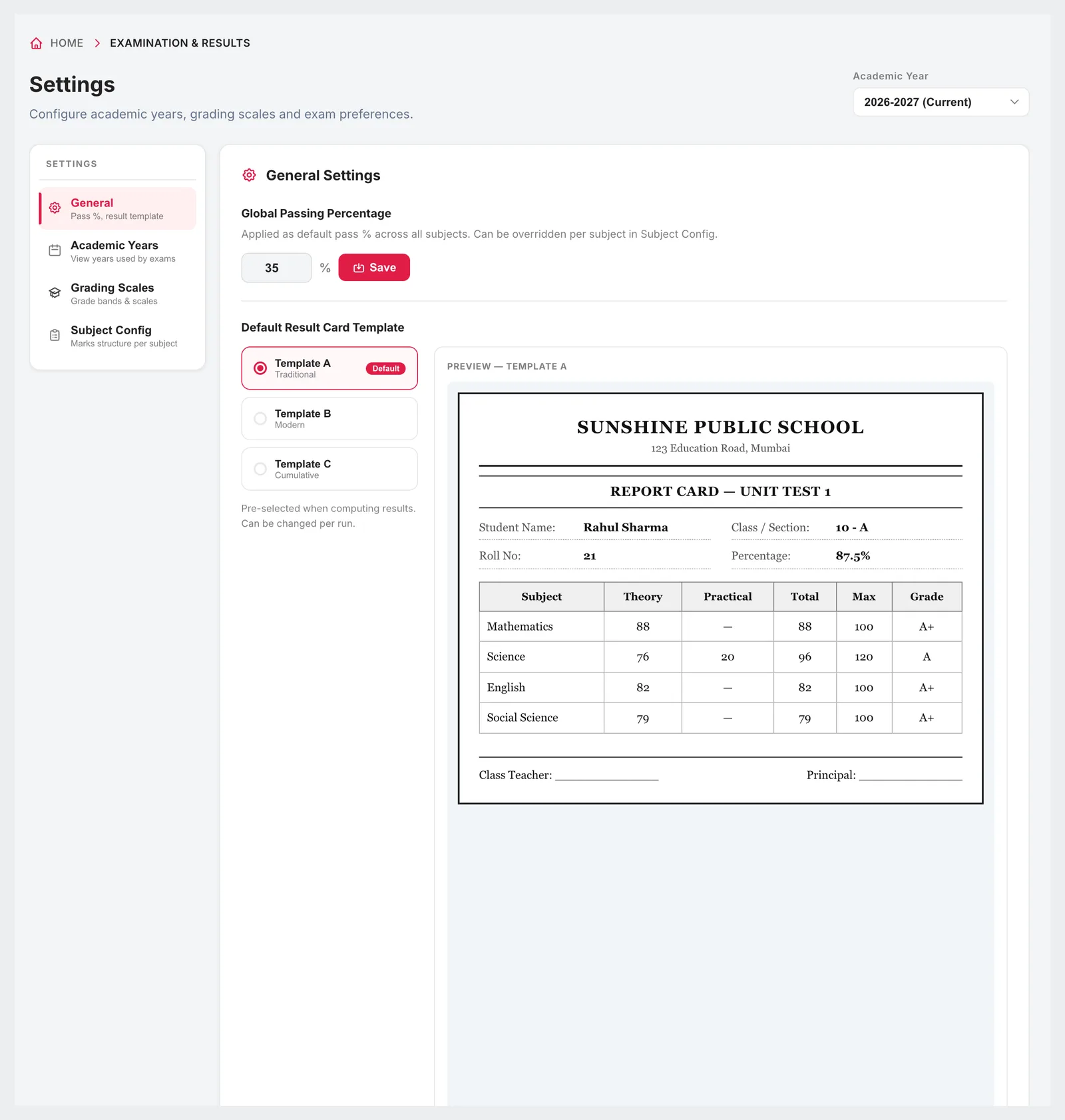
Campus 24x7 examination settings showing a global passing percentage of 35%, the Grading Scales and Subject Config tabs, three result card templates (A Traditional, B Modern, C Cumulative) and a preview of Template A — a report card for Rahul Sharma, class 10-A, with theory, practical, total, max and grade columns for Mathematics, Science, English and Social Science, and a percentage of 87.5%
The exam settings screen: pass percentage, grading scales and the three result card templates, with Template A previewed.

What the exam module does not do

  • Board-specific report card formats are not built in. You pick one of the three templates and set your own grading bands.
  • Marks are entered by teachers in the web app. There is no OMR scanning or answer-sheet import.
  • Attendance reports in the Reports module are still marked coming soon; attendance is reviewed in its own daily, weekly and monthly views.
Reaching Tamil-first parents

The notice that was read because it was in Tamil

An English circular in a diary reaches the parents who read English and surfaces on Saturday for everyone else. Chennai is the one metro on this site where that gap is the whole problem.

  • Messages go from your school's own WhatsApp Business number, not a shared gateway number parents will not recognise
  • Templates in Tamil, English and Hindi — Meta approves each one, in each language, during setup
  • Fee receipts, absence alerts, exam results and the daily overdue reminder go out on their own once switched on
  • Send to chosen classes and sections, or narrow by fee status — unpaid or overdue — before you send
  • Delivery status on every message: sent, delivered, read or failed, exportable as CSV

Worth planning for: WhatsApp only lets a business open a conversation with a template Meta has approved, and each language is approved separately. A Tamil version and an English version of the same notice are two submissions — we handle them during setup, but it is why the language list is settled early rather than switched on later.

The first fifteen minutes

Attendance that finishes before first period

When the register is marked in class and keyed in later, the absence that mattered is noticed at lunch. This is the same morning with the roster on a phone.

  1. 7:55

    Teacher marks at the door

    The roster opens in a phone browser, so the class teacher marks everyone present in one tap and changes the few who are absent — without walking to the staff room first.

  2. 7:56

    The absence alert fires itself

    Each absent student's parent gets the ready-made WhatsApp alert from your school's number: the child's name, class, section and date. At most one per child per day, even if the register is saved again.

  3. 8:10

    The office sees the number, not a pile of registers

    Attendance percentage, present, absent and not-marked totals for the whole school, next to yesterday's figures, so the classes nobody has marked are obvious.

  4. Same day

    The follow-up is a filter, not a list

    Rather than a printed pending sheet, the fee campaign narrows to unpaid or overdue families in the classes you choose and messages them directly.

No biometric, no RFID and no face recognition — attendance is marked by staff in the web app. Corrections are possible afterwards with a reason recorded against the student.

What changes

The same seven jobs, done differently

AreaHow it runs on paperOn Campus 24x7
AdmissionsPaper forms, then re-typing the same details into ExcelA five-step form that creates the student record, class placement, roll number and parent login at once — or a CSV for the students you already have
AttendanceRegister marked in class, carried to the office, keyed in laterMarked on a phone at the classroom door; the parent alert goes out in the same minute
FeesCounter collection, handwritten receipts, a pending list printed each morningInvoices generated nightly with late fines applied, receipts sent on WhatsApp, and the overdue reminder running daily on its own
ExamsTwo marking patterns rebuilt in spreadsheets every termEach pattern configured once — weightage, pass mark, grading bands — then results compute and publish
Parent communicationEnglish notice in a diary, or a translation typed into a WhatsApp groupApproved Tamil, English and Hindi templates from the school's own number, with delivery status on each
TransportCalling the driver to find out where the bus isThe bus on a live map while the trip is running, from the driver's phone — no tracker fitted to any vehicle
Branch reconciliationEach campus emails its own Excel at month endEvery branch posts into one ledger, readable together or separately
Who this fits

Three ways Chennai schools start

State Board schools going digital first time

  • Start with attendance, fees and WhatsApp in the first month
  • Bring existing students in by CSV rather than re-typing them
  • Parents get Tamil messages from a number they recognise

CBSE campuses running terms and internals

  • Term weightage and internal components set per subject
  • A 10-point CGPA scale with bands you define
  • Results publish to parents and fire the result message in one step

Trusts running both boards, or several campuses

  • Two marking patterns configured side by side, in one account
  • One admin login to read the branches together or separately
  • The same fee heads, fine policy and templates applied everywhere
By the numbers

What you get, counted

7Template languages

English (US and UK), Hindi, Tamil, Telugu, Kannada and Malayalam, each approved by Meta separately.

3Grading scales

Percentage bands, a 10-point CGPA, or grades only — with the bands set by you.

6Automations that run themselves

Admission welcome, fee receipt, absence alert, exam result, daily overdue reminder and birthday wishes.

2 monthsFree to start

Every plan begins with two months free; regular billing starts from month three.

What it costs

Priced by student strength

Annual billing shown. Monthly is available on each plan, and every plan includes two months free. If buses are part of why you are shopping, compare Growth — transport and live tracking are not part of Foundation.

Foundation₹29,999 / year

Up to 500 students and 30 teachers & staff. Transport is not included on this plan.

Scale₹1,09,999 / year

Up to 2,500 students and 100 teachers & staff, with transport across every branch.

Campuses above 2,500 students are quoted individually. See the full plan comparison.

The platform

What every Chennai school gets on day one

  • Role-based logins — principal, accountant, class teacher, librarian, transport in-charge — with defaults you can extend
  • Parent, student, teacher and driver apps on Android
  • Nightly invoice generation with your own late-fine policy applied
  • Documents stored on the student record, not in a shared drive
  • Encrypted storage with backups, and multi-branch support on one account
  • Marks, fees and attendance all exportable, so your data stays yours
Questions we get from Chennai

Asked before every demo here

Does Campus 24x7 produce Tamil Nadu State Board report cards?

Not board-branded ones — it is worth being precise about this. Board-specific report card formats are not built in. What you get is three result card templates (traditional, modern and cumulative) and a grading scale whose bands, points and pass marks you define yourself, plus a marks structure set per subject with theory, practical and internal components. That is enough to run a State Board annual pattern and a CBSE term pattern side by side in the same school, and each card downloads as a PDF. If you need an exact board-issued layout, ask us during the demo and we will show you the three templates against your current card so you can judge the gap yourself.

Can we send messages to parents in Tamil?

Yes. Templates are supported in English (US and UK), Hindi, Tamil, Telugu, Kannada and Malayalam, and they go out from your school's own WhatsApp Business number. One thing to plan for: WhatsApp only allows businesses to open a conversation with a template Meta has approved, and each language is approved separately — so a Tamil version and an English version of the same notice are two approvals. We handle the submissions during setup.

Can parents pay fees online?

Yes. Parents can see their dues, payment history and receipts in the Campus 24x7 app, and the office can also record payments taken by cash, UPI, card, cheque or bank transfer so the ledger stays complete either way. Receipts go out on WhatsApp automatically, and invoices generate nightly with your late-fine policy applied.

Can parents apply for admission online?

Not today, and we would rather say so here than at the demo. Admissions are entered by your office through a five-step form, or in bulk from a CSV for students you already have. There is no public application form, no merit list, and nothing that tracks or chases prospective families before they are admitted. What the form does give you is everything downstream in one action: the student record, class placement, roll number, parent account and the logins for the parent and student apps.

How does bus tracking work, and what does it not do?

Location comes from the driver's phone running the driver app, so there is no GPS hardware to buy, fit or maintain in any vehicle. While a trip is running, the bus is on a live map and stop events are recorded. The limits are worth knowing before you buy: there is no arrival-time estimate, no push alert when the bus nears a stop, and parents see the bus only while the driver has the trip running. Transport is included from the Growth plan onward, not on Foundation.

Do you support biometric or RFID attendance?

No. Attendance is marked by staff in the web app — the roster opens in a phone browser so a class teacher can mark at the classroom door, mark everyone present in one tap, then change the few who are absent. Corrections are possible afterwards with a reason recorded. There is no biometric, RFID or face-recognition attendance.

We run campuses in different parts of Chennai. Does that work on one account?

Yes. Multi-branch is supported on a single account: every branch posts into one ledger, and an admin login can read the branches together or separately. The same fee heads, fine policy and message templates can be applied across all of them, which is usually the part that drifts when each campus keeps its own spreadsheet.

What does it cost, and how long does setup take?

Plans are priced by student strength and billed annually: Foundation at ₹29,999 for up to 500 students, Growth at ₹49,999 for up to 1,000, and Scale at ₹1,09,999 for up to 2,500. Every plan starts with two months free, with regular billing from month three. Monthly billing is available. Most schools begin with attendance, fees and communication, then add exams and transport — bringing existing students in by CSV is usually the longest single step.

See it running on your own marking pattern

We will set up a demo with your classes, your fee heads and your actual grading bands — both boards, if you run both — so you are not looking at sample data. Your first two months cost nothing.