Student Information Management System for Schools — One Record, Every Detail, Always Accessible
A student in Class 9 at a school in Hyderabad needs a duplicate marksheet from Class 6 — her family is applying for a scholarship and needs the original-certified copy. The class teacher who handled Class 6 left the school two years ago. The physical marksheet file for that academic year is in a storage room with 47 other folders. The academic coordinator spends three hours finding it. The scholarship deadline is tomorrow. This is the cost of student information that exists but isn't managed — and why a student information management system is the foundational layer every Indian school needs.
Student data doesn't disappear — it just becomes inaccessible when it's stored in physical files, individual teacher registers, and disconnected spreadsheets. The system that fixes this isn't a filing cabinet upgrade — it's a single, searchable record that follows the student from admission to alumni.
What Student Information Management Actually Covers
If you are comparing vendors rather than scoping the category, the best student information systems for schools runs through the shortlist. Alongside the record itself sits the paperwork: school document management covers storing and retrieving the certificates an SIMS points at. Most administrators think of student information as basic demographics — name, class, parent contact. A complete SIMS covers the full student lifecycle:
Admission data: application details, admission date, class and section, admission number, previous school details, documents collected. Where the admission management system feeds the SIS directly, this arrives without re-entry.
Personal and family information: full legal name, date of birth, blood group, nationality, religion, category (General/OBC/SC/ST), emergency contact, medical conditions, sibling records.
Academic history: year-wise class progression, subject choices, marks and grades per exam, co-scholastic records, attendance percentage per year.
Financial records: fee structure assigned, payment history, scholarship or concession details, outstanding balance.
Document records: admission documents, report cards, board exam results, certificates issued.
Communication history: circulars received, attendance alerts sent, fee reminders, PTM invitations.
This is one student record — not 8 different files in 8 different places.
The Student Data Problems Schools Live With Daily
Problem 1: No single source of truth. The class teacher has one version of the student list. The fee department has another. The transport coordinator has a third. When a student changes section or updates their address, the update doesn't propagate — each department continues with their version of the data. Conflicts surface at the worst times: during report card generation or compliance audits.
Problem 2: Data loss at staff transition. When a long-serving class teacher or academic coordinator leaves, they take institutional knowledge with them. Student records maintained in personal Excel files or teaching diaries don't transfer. Schools report losing 2–3 years of student academic history when a key staff member exits without proper data handover.
Problem 3: Manual TC generation. Transfer Certificate generation requires pulling data from multiple sources — admission register, fee clearance confirmation, attendance record, last exam result. Manual TCs take 20–30 minutes each. With an integrated system, all data is in one place — TC generated in under 2 minutes.
Problem 4: No academic progression view. Seeing a student's journey from Class 1 to Class 10 — year-wise performance, attendance trends, fee payment history — requires compiling across 10 years of separate registers. Almost never done in practice.
Problem 5: UDISE and government reporting. UDISE+ requires student-level data in specific formats. Schools without a SIMS spend weeks manually compiling data that should be exportable in minutes.
What a Student Information Management System Does — End to End
Admission to record creation. When a student is admitted, their record is created in the system — all admission data entered once, linked automatically to fee management, attendance tracking, and communication. No re-entry across departments. For schools that accept applications online, the data flows directly from application to student record. See how this works in detail with online admission management.
Year-on-year progression. At year-end, students are promoted to the next class — their complete history moves with them. Section changes, subject changes, teacher assignments — all updated centrally, all reflected everywhere immediately.
Real-time data access. Principal searches any student by name, admission number, or class — full profile available in 3 seconds. No file search, no inter-department calls.
Integrated data flows. Attendance marked — automatically reflects in student profile. Fee paid — automatically reflects in financial record. Exam results entered — automatically updates academic history. No manual updating across multiple systems. The attendance management system and fee management system feed data directly into the student record without any staff intervention.
TC and certificate generation. All data for TC is already in the system. TC generated with one click — accurate, formatted, with digital reference number.
UDISE and compliance export. Student data exportable in UDISE+ prescribed formats — one-click report, not a weeks-long manual exercise. For colleges, this same structured data approach extends to NAAC accreditation data management, where SSR compilation depends on retrievable, auditable student records. For multi-campus institutions, this student data sits inside a broader campus management system.
Student Data Privacy — What Indian Schools Need to Know
Student data is among the most sensitive personal data an institution manages. With India's Digital Personal Data Protection Act (DPDPA) 2023 now operative, schools that collect and store student data have specific obligations:
Data must be collected with explicit consent from parents. Access must be controlled — only authorised personnel can view student personal data. Data must be stored securely — encrypted, with access logs. Students and parents have the right to request data correction or deletion.
A SIMS with role-based access control, encryption, and audit logs is not just operationally useful — it's a compliance requirement under Indian data protection law. Schools still managing student data in unprotected Excel files or paper registers have no mechanism to enforce any of these requirements.
Key Features of a School SIMS
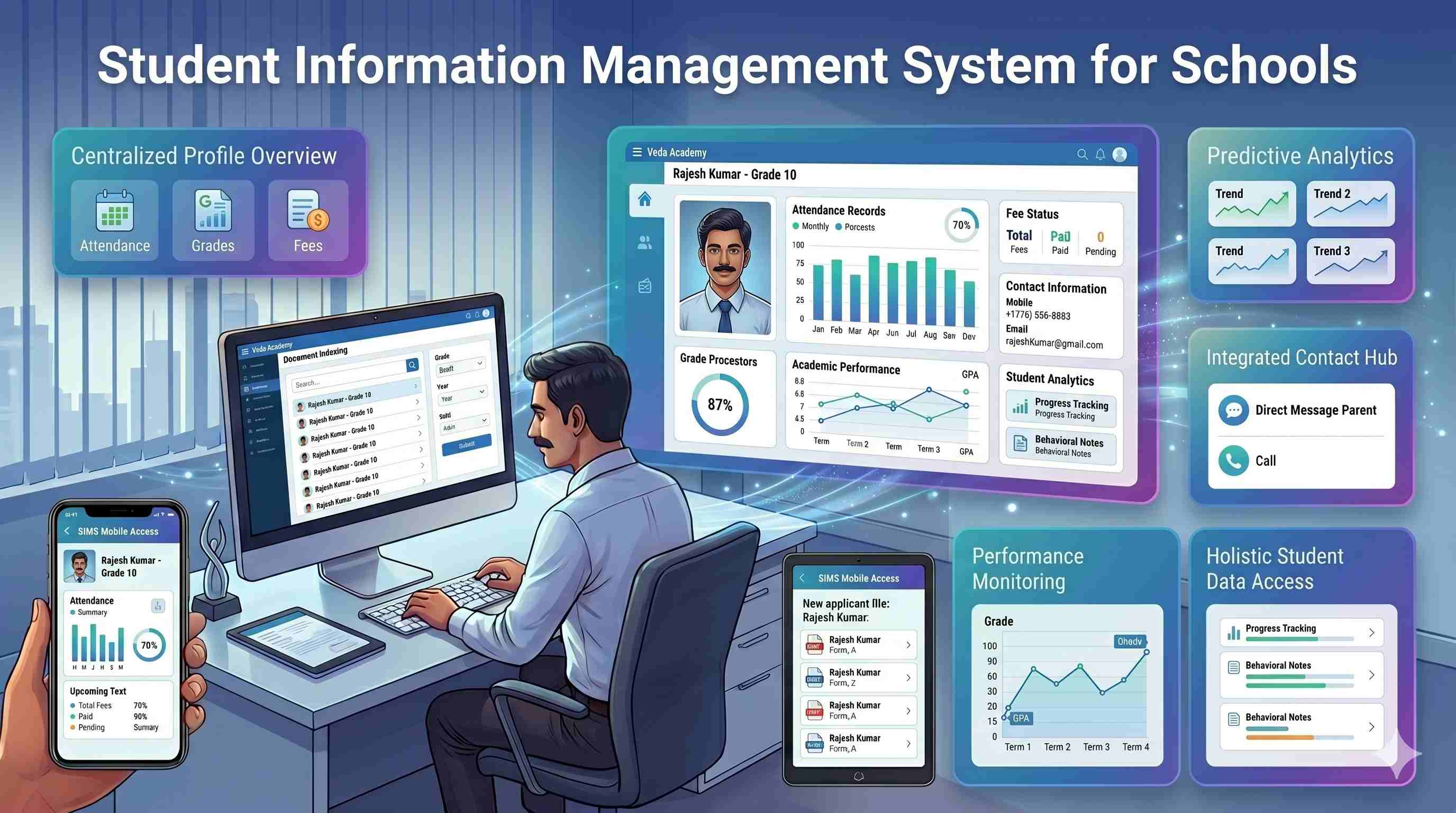
1. Complete student profile. 360-degree view — demographics, academic history, financial records, documents, communication log — all in one place.
2. Multi-year academic progression tracking. Class-by-class history maintained automatically as students are promoted year-on-year.
3. Role-based data access. Teacher sees their section. Accounts sees fee records. Principal sees everything.
4. One-click TC generation. All required data already in the system. TC generated, formatted, and digitally archived in under 2 minutes.
5. UDISE+ and government report export. Student data exportable in prescribed government formats without manual compilation.
6. Sibling and family linking. Sibling records linked — fee discounts, family communication, and emergency contacts managed at family level.
How Campus 24x7 Handles Student Information Management
Campus 24x7 treats the student record as the central data object in its school ERP software in India. Every module — admissions, attendance, fees, academics, communication — reads from and writes to the same student profile. There is no separate database per department.
When a student is admitted, their record is created once. Attendance data, fee payments, exam results, and parent communication all accumulate against that single record automatically. TC generation pulls from the same profile — no data gathering required. UDISE+ exports are generated directly from student records in the prescribed format.
Role-based access ensures class teachers see only their section, accounts staff see only financial data, and the principal has full access with audit logging. Data is encrypted at rest and in transit, aligning with DPDPA requirements.
Schools moving from Excel or a previous ERP can import existing student data via structured CSV templates — Campus 24x7's onboarding team assists with data migration for all new institutions.
Frequently Asked Questions
What is a student information management system?
A student information management system (SIMS) is the school’s single digital record for each learner — admission data, class progression, parents, attendance, fees, exams, and documents — with role-based access and audit history. Unlike Excel, it enforces one profile per student and feeds TCs, UDISE+ exports, and report cards from the same source.
What is the best student information system for Indian schools?
The best student information system is the one your staff will update daily and that exports UDISE+, board reports, and TCs without retyping. Prefer a SIMS embedded in a full school ERP software in India so fees and attendance write to the same profile. Campus 24x7 is built around that central student record for CBSE and state board schools.
What is an institute student management system?
An institute student management system is the same idea at college or multi-programme scale: department-wise enrolment, semester progression, and compliance exports instead of only K–12 class sections. Schools and colleges both need one authoritative student database; Campus 24x7 covers school SIMS workflows and extends into campus management for higher-education institutes.
What is a student information system for schools in India and how is it different from an Excel sheet?
A student information system school India schools rely on is a single, structured profile per child — not a spreadsheet row that gets copied into three other files. Excel cannot enforce role-based access, track who edited a field, link siblings, or export UDISE+ formats in one click. When a Class 9 student in a Bhopal CBSE school needs a TC, a SIMS pulls six years of records instantly. Excel requires the clerk to gather files from four departments over two days.
What should SIMS school software in India include for CBSE and state board schools?
Essential modules cover admission data, class progression, parent and emergency contacts, fee ledger links, attendance history, exam results, document storage (Aadhaar, caste certificate, transfer papers), and board-specific report card data. For state board schools in Maharashtra or UP, the SIMS school software India must also support local grading schemes and government export formats. Campus 24x7 includes UDISE+ export, sibling linking, and DPDPA-aligned access controls as standard — not optional add-ons.
How does student database management help during UDISE+ reporting in Indian schools?
UDISE+ deadlines create annual panic in schools still using registers. Proper student database management school workflows keep category (General/OBC/SC/ST), medium of instruction, disability status, and enrolment counts accurate throughout the year — not compiled in a frantic week in September. When data lives in one system updated daily, the principal exports the prescribed format, validates totals against class registers, and submits without hiring temporary data-entry staff.
Can Indian schools migrate years of student records into a SIMS without losing data?
Yes, with structured migration. Campus 24x7 provides CSV templates mapped to standard fields — name, DOB, class, parent contact, fee history where available. The onboarding team validates imports before go-live, flags duplicates, and runs sample TC and report card tests. Schools in Hyderabad and Chandigarh with 8–10 years of Excel archives typically complete migration in one to two weeks during summer break, then run one term parallel before decommissioning old files.