School ERP Software Price in India: Every Number, 2026
Most pages that rank for this question will not give you a number. They explain that pricing "depends on your requirements" and ask you to book a demo.
This page gives you the numbers.
Below are the per-student bands the Indian market actually charges in 2026, what a 500-student, 1,000-student and 2,500-student school ends up paying per year, the five charges that routinely appear after the quote is signed, and a method for putting two proposals on the same basis so you can compare them honestly.
The Short Answer
Indian school ERP software is priced between ₹8 and ₹15 per student per month for core modules on a cloud subscription. For a 500-student school, that is roughly ₹48,000 to ₹90,000 a year.
That is the band most vendors quote within. Prices below it usually mean modules are missing or the per-student rate steps up sharply after an introductory year. Prices above it usually mean either genuine enterprise capability — multi-branch consolidation, SIS-grade audit trails, custom integrations — or simply a sales process with room to negotiate.
Two structures exist in the market:
Per-student pricing. You pay a rate per enrolled student per month. Transparent, and it scales with you. The risk is that the rate is quoted at your current enrolment and your bill grows every admission cycle whether or not you are using more of the system.
Plan-based pricing. You pay a flat monthly or annual fee for a tier with a student ceiling. Predictable, and the effective per-student rate falls as you fill the tier. The risk is paying for headroom you never use, and a cliff when you cross the ceiling.
Neither is inherently better. Plan pricing suits schools with stable enrolment and a budget that must be fixed a year in advance. Per-student suits schools growing fast enough that they would rather pay in step with that growth.
What Each School Size Actually Pays
Here is what the market charges annually, by size, for core modules on an annual billing cycle.
| School size | Typical market band (per year) | Effective per-student/month |
|---|---|---|
| Up to 500 students | ₹48,000 – ₹90,000 | ₹8 – ₹15 |
| 500 – 1,000 students | ₹90,000 – ₹1,60,000 | ₹7.50 – ₹13 |
| 1,000 – 2,500 students | ₹1,60,000 – ₹3,20,000 | ₹5 – ₹11 |
| 2,500+ students / multi-branch | ₹3,20,000+ | Negotiated, often ₹4 – ₹8 |
The per-student rate falls as you grow. This is normal — the vendor's cost of serving you does not rise linearly with enrolment, and the larger contracts are competitive.
Within any given size, quotes separate into three bands by what is included:
| Band | Per student / month | 500-student school / year | Typically includes |
|---|---|---|---|
| Entry | ₹5–8 | ₹30,000–48,000 | Fees, attendance, basic report cards, parent app |
| Mid | ₹8–12 | ₹48,000–72,000 | Above plus transport, library, exams, WhatsApp |
| Upper | ₹12–15+ | ₹72,000–90,000+ | Above plus branded app, analytics, multi-campus, SSO |
Two cautions on these figures. A per-student rate is only meaningful alongside the student count it assumes, because most vendors price in tiers and a school well below a tier ceiling pays more per head than the headline rate suggests. And bands move — treat them as a sanity check on a quote you receive, not as a number to hold a vendor to.
Schools under about 300 students should expect the per-student figure to look worse than these bands. Almost every vendor has a floor price, and below roughly 200 students you are paying that floor regardless of headcount. This is the single most common surprise for small schools, and it is not a vendor being unreasonable — it is the fixed cost of hosting, support and onboarding not shrinking below a certain point.
For reference, our own plans sit at the lower end of these bands:
| Plan | Students | Monthly | Annual | At the ceiling |
|---|---|---|---|---|
| Foundation | Up to 500 | ₹2,999 | ₹29,999 | ₹5.00/student/month |
| Growth | Up to 1,000 | ₹4,999 | ₹49,999 | ₹4.17/student/month |
| Scale | Up to 2,500 | ₹10,999 | ₹1,09,999 | ₹3.67/student/month |
Full module lists are on the pricing page. The comparison that matters is not our number against the band — it is what is inside each quote, which is where most of the real cost variance lives.
What Pushes a Quote Up
Five things, in roughly the order they appear on invoices.
1. Module count. Core is admissions, fees, attendance, examinations, timetable and communication. Transport with GPS, hostel, library, payroll, inventory and accounting are commonly separate line items. A quote that looks 30% cheaper is often a quote with four fewer modules.
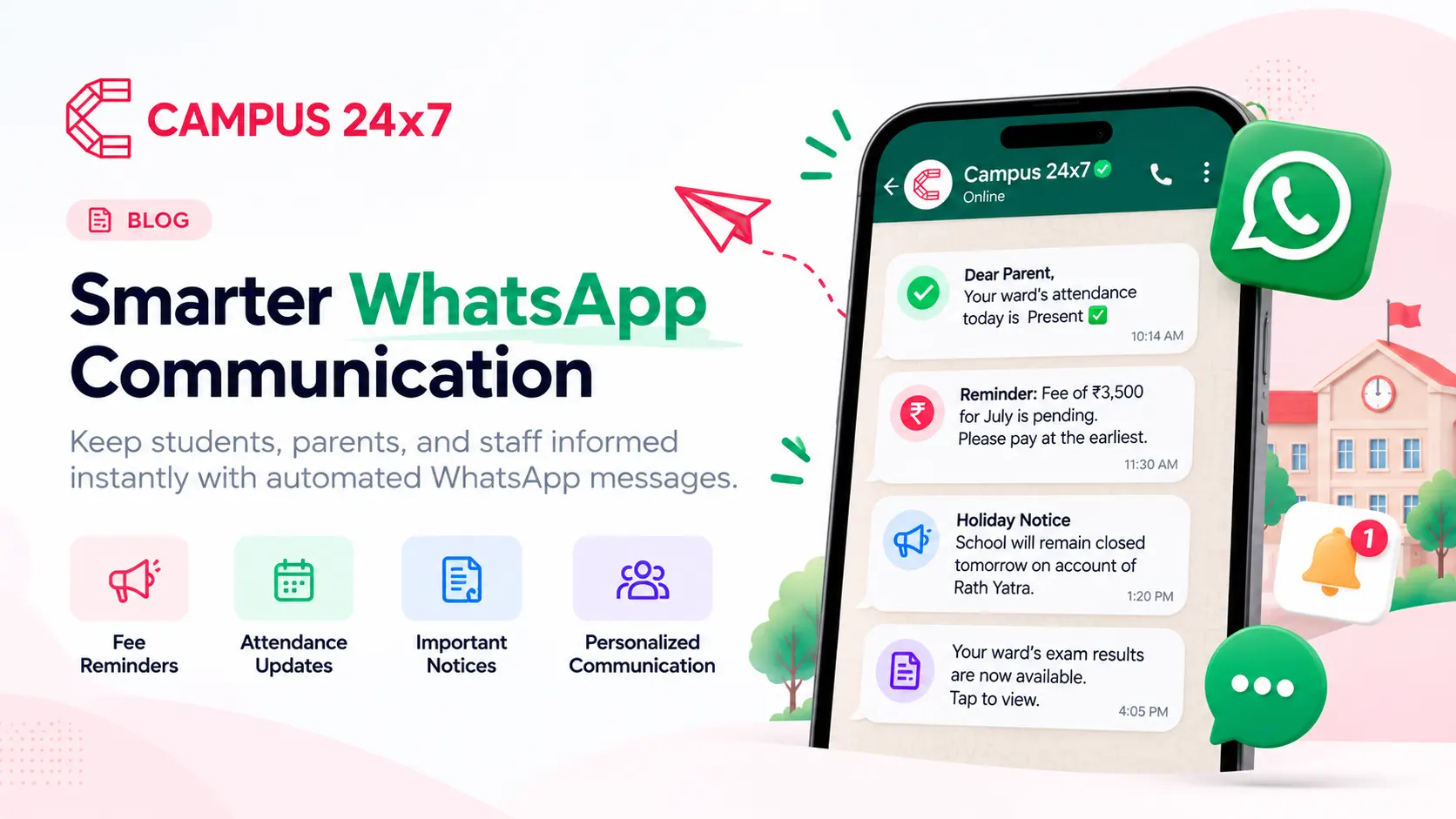
2. Communication volume. SMS is billed per message, almost universally. WhatsApp is billed per conversation under Meta's pricing, and a school sending daily attendance alerts to 800 parents generates a real monthly number. Ask for the per-unit rate and multiply it by your actual message volume — not the vendor's example volume.
3. Implementation and data migration. One-time, and it ranges from free to ₹50,000 depending on the state of your current records. If your data is in several Excel files maintained by different people with inconsistent student IDs, migration is genuine work and will be priced as such.
4. Training. Usually a fixed number of sessions, with additional sessions chargeable. The number that matters is not sessions delivered but whether teachers are still using the system in March. Ask what happens when you hire six new teachers in April.
5. Branches. Multi-branch is priced as a tier, not a per-branch multiple, by most vendors — but confirm this explicitly. "Per branch" versus "per total student count across branches" versus "flat trust licence" produce very different numbers at four branches.
The Charges Quotes Leave Out
These are the ones that surface after signature. Ask about each in writing before you commit.
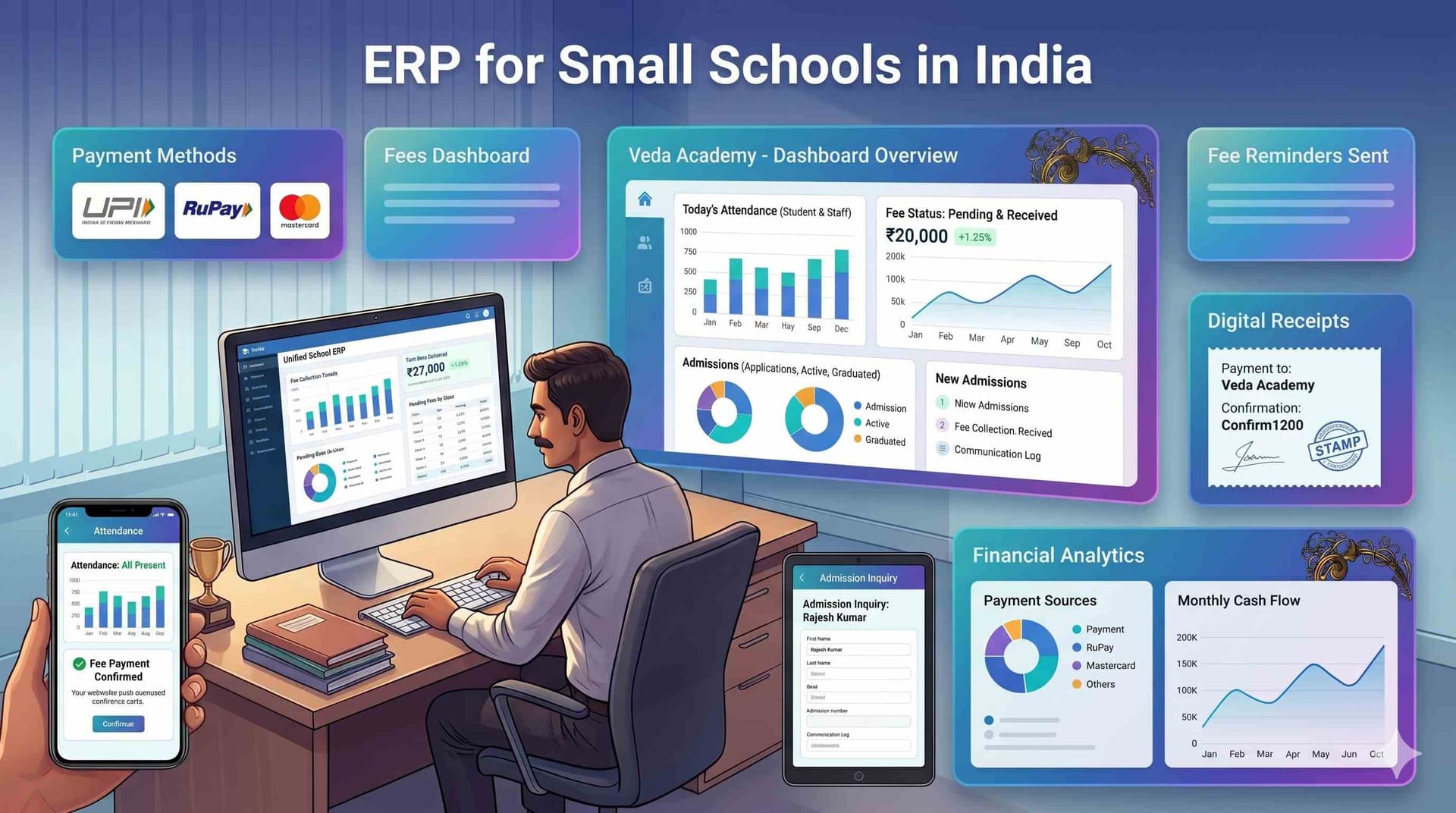
Payment gateway charges on fee collection. If parents pay online, someone pays the gateway. Card and net-banking payments commonly carry charges in the region of 1.5% to 2%, while UPI is often priced lower — rates differ by gateway and by method, so ask for the rate per payment method. Our guide to school fee collection software covers settlement times and who should bear the charge. Clarify whether the school absorbs the charge, the parent pays a convenience fee, or it is bundled. At card-like rates, ₹2 crore of annual collection costs ₹3–4 lakh in charges — more than the ERP subscription itself, which is why steering parents towards cheaper methods matters.
Annual price escalation. Many contracts include a yearly increase; ask for the exact percentage and whether it is capped. For scale: at 8% a year, ₹90,000 becomes about ₹1,22,000 by year five. Ask for the escalation clause specifically.
Data export on exit. The question to ask is: if we leave in year three, what do we get and in what format? The answer should be complete data in a standard format at no charge. Anything else is lock-in, and it is worth knowing before you are inside it.
Support response times. "Email and chat support" is not a commitment. Ask what happens when fee collection breaks on the last day of the quarter. A named response window during Indian business hours is a different product from a ticket queue.
Storage and audit-log retention. Document storage caps and audit-log windows (30 days versus 12 months) differ sharply between tiers and matter enormously if you are preparing for a board inspection or a NAAC cycle.
How to Compare Two Quotes Fairly
Vendors quote on different bases, which makes headline numbers close to meaningless. Normalise before you compare.
Step 1 — Build a five-year total, not a monthly figure. Subscription × 60 months, plus one-time implementation, plus migration, plus training, plus estimated annual communication spend, plus the escalation clause applied each year. Most comparisons flip at this step.
Step 2 — List modules side by side and mark the gaps. Put every module you actually need in a column and tick what each quote includes. Price the gaps at the vendor's own add-on rate. A cheaper quote missing transport and library is not cheaper.
Step 3 — Normalise the student count. If one vendor quotes per-student and another quotes a plan, compute the plan's effective per-student rate at your real enrolment, not at the tier ceiling. A ₹4,999 plan for up to 1,000 students is ₹8.33 per student at 600 enrolled, not ₹4.17.
Step 4 — Price your actual message volume. Count the messages you genuinely send: daily attendance, fee reminders, exam results, event notices. Multiply by each vendor's per-unit rate. This line item varies more between vendors than the subscription does.
Step 5 — Ask all five exit questions. Escalation, data export, support window, storage caps, audit retention. Get the answers in writing. A vendor who will not put these in writing has told you something useful.
Is Free School ERP Software Worth It?
Free tiers exist and are genuinely useful in two situations: a school under about 150 students, and a school that wants to test whether staff will adopt any system at all before spending money.
Beyond that, the constraints bite in predictable places — student caps, no WhatsApp integration, no online fee collection, community-forum support, and limited or no data export. That last one is the one to check first, because it determines whether your trial is reversible.
A reasonable path is to trial a paid system properly rather than commit to a free one. We give two months at ₹0 on every plan with full access, which is long enough to run a real fee cycle and find out whether teachers use it. The free versus paid comparison covers where the lines fall in more detail.
What a Fair Quote Looks Like
For a 700-student CBSE school wanting core modules plus transport, on annual billing:
- Subscription: ₹90,000 – ₹1,20,000 per year
- Implementation and migration: ₹0 – ₹25,000 one time
- Training: included, with a stated number of sessions
- WhatsApp/SMS: ₹1,500 – ₹4,000 per month at realistic volume
- Escalation: stated in the contract, ideally capped
- Data export: free, complete, standard format
If a quote sits inside that shape and the vendor answers the five exit questions in writing, it is a fair quote. If it is far below and the module list is short, the gap will reappear as add-ons by year two.
Frequently Asked Questions
What is the average cost of school ERP software in India? Between ₹8 and ₹15 per student per month for core modules, which works out to roughly ₹48,000 to ₹90,000 a year for a 500-student school. Larger schools pay a lower per-student rate.
Is school ERP priced per student or as a flat fee? Both exist. Per-student scales with enrolment and is transparent; plan-based pricing is predictable and gets cheaper per student as you fill the tier. Compare them by computing the plan's effective rate at your actual enrolment, not at the tier ceiling.
Does school ERP software have hidden costs? The common ones are payment gateway charges on online fee collection (commonly 1.5–2% on cards and net banking, often lower on UPI), per-message SMS and WhatsApp billing, one-time data migration, annual price escalation, and charges for data export on exit. None are unusual; all should be disclosed before signing.
How much does implementation cost? ₹0 to ₹50,000 as a one-time charge, driven mostly by the condition of your existing records. Clean, consistent data migrates cheaply. Several inconsistent spreadsheets do not.
Can a small school afford an ERP? Yes. Under 500 students, the realistic annual band is ₹30,000 to ₹90,000 — comparable to one part-time administrative salary. The guide for small schools covers what to prioritise on a tight budget.
What should I ask before signing? The five that are most often skipped: what is the annual escalation, what do we get on exit and in what format, what is the guaranteed support response window, what are the storage and audit-log caps, and what is the per-message communication rate.
Next Steps
If you are comparing vendors now, the 10-step evaluation framework covers the non-price criteria, and the implementation checklist covers what happens after you sign.
Our plans and full module lists are on the pricing page. Every plan includes two months at ₹0 with full access — enough to run an actual fee cycle before you decide.