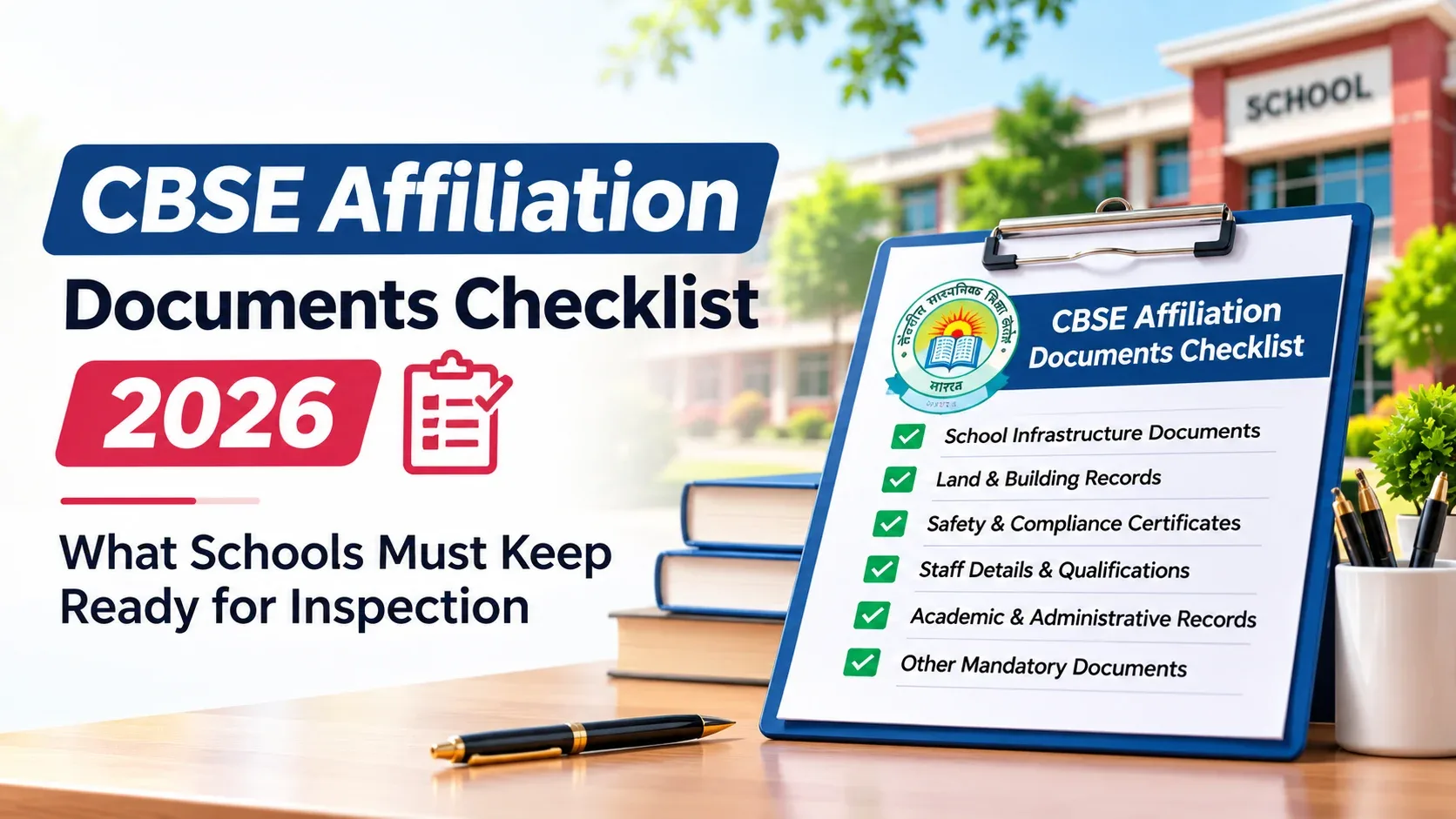
CBSE Affiliation Documents Checklist 2026: What Schools Must Keep Ready for Inspection
Most schools treat affiliation paperwork as a one-time event — a file assembled in a panic, submitted, approved, and then forgotten until the next renewal or inspection.
That framing is what causes the panic. The Affiliation Bye-Laws split the requirement in two: documents you submit when applying, and records you maintain continuously for as long as you stay affiliated. The second list is longer than the first, and it is the one that catches schools out, because nobody assembles it in advance. An inspection asks for records that were supposed to exist all along.
This post covers both lists, what the Bye-Laws actually say about each, and the part most schools underestimate — the public disclosure obligation on your own website.
A Note on Sourcing Before You Rely on Any Checklist
Clause references below are to the CBSE Affiliation Bye-Laws 2018 (notified 18 October 2018, D.O.No.CBSE/AFF-B.L/SECY/2018), which remains the governing document.
But the Bye-Laws have been amended several times since, and some amendments change requirements materially. Two worth knowing about:
- July 2025 — revisions to Appendix-V under Chapter 3 took effect immediately, changing how maximum sections are calculated. Section caps now derive from the school's total built-up carpet area, certified by the local body or a licensed architect, rather than from land area alone. Land area now determines only the school category.
- 2024–2025 circulars amended the land certificate and building safety certificate requirements, and changed the position on applying with or without a state NOC.
This matters more than it sounds. Any checklist you find online — including this one — is a secondary source. Before you submit anything, open the current SARAS portal and read the live requirement list and the prescribed Appendix formats there. Formats are prescribed strictly, and a certificate on the wrong proforma is rejected even when the underlying fact is true.
Treat what follows as a preparation guide, not as the submission list of record.
Part 1: Documents Required for Affiliation
Government permissions
Recognition Certificate — issued by the State Education Department (clause 2.3.4). This remains mandatory. A school cannot route around state recognition by applying directly to CBSE.
No Objection Certificate (NOC) — issued by the State Government (clause 2.3.5), applicable to schools covered under clauses 2.1.5 to 2.1.8. The position on whether a school may apply without an NOC has been amended by circular, which is exactly the kind of detail to confirm on SARAS rather than from a blog.
District Education Officer certificate — on the prescribed proforma, Appendix-II for fresh affiliation and Appendix-III for extension or upgradation (clause 2.3.9). The 2018 regime leans on the DEO verifying your documents locally, which is why this certificate carries weight.
Self-affidavit — on the Appendix-IV sample format (clause 2.3.9). The school issues this itself. Understand what you are signing: schools have been told that if uploaded documents are later found not to be genuine, the school is liable for action as per norms.
Land and building
Land documents — the Sale Deed, Conveyance Deed, Gift Deed, Lease Deed or Allotment Letter establishing the society's or trust's title (clause 3.8.1).
Land area requirements — clause 3.2 sets a minimum of 8,000 sq m, and clause 3.3 provides for not less than 6,000 sq m, both subject to Appendix-V. Given the July 2025 Appendix-V revision, read the current Appendix-V rather than these figures alone.
Built-up carpet area certificate — now central, because section capacity is calculated from it. Certified by the local body or a licensed architect.
Building safety / structural stability certificate — on the prescribed format, amended by circular. Check the current proforma.
Fire safety certificate — this one has a specific trap worth stating plainly. The certificate must be issued by the government fire safety department. A letter confirming that you have installed or possess fire extinguishers or fire safety equipment is not a fire safety certificate and will not be accepted in its place.
Water and sanitation — safe drinking water certificate, and health and sanitation certificates.
The society or trust
Registration certificate of the society, trust or company, its Memorandum of Association and rules, and the list of members. Where the society's name has changed, the name-change certificate is required (clause 15.6.2).
An affidavit on the non-proprietary character of the managing society or trust is a long-standing requirement in this set — the school must not be run as a proprietary concern.
Financial
Audited balance sheets and financial statements, typically for the preceding three years, certified by a Chartered Accountant. Reserve fund evidence. EPF registration in the school's name and staff EPF deduction challans.
The Bye-Laws index includes a specific provision at 6.7, "Separate Register For All the Loans" — a reminder that financial record-keeping obligations are itemised, not general.
Staff
Appointment letters, self-attested copies of qualification certificates (clause 5.2.6), and medical and character certificates (clause 5.3.2). Teacher qualifications must meet the requirements set out in Appendix-VII.
Process documents
Appendix-I sets the schedule of fees under various heads. Appendix-VI sets the time frame for submitting applications — worth reading early, because missing a window costs you a full session.
Appendix-VIII, the Commencement Certificate, is one schools forget. Under clause 2.4.14 the school submits it before starting classes VI, IX or XI. Initial affiliation is granted for three years (clause 2.7), so the renewal clock starts the moment you are approved.
Part 2: The Records You Must Maintain Year-Round
This is the list that decides how an inspection goes. Clause 14.19, "Records/Documentation", is the operative provision, and the registers it names are supposed to be current at all times.
Admission and withdrawal register (14.19(a)) — the continuous record of every student entering and leaving.
Attendance records (14.19(c)) — maintained and retrievable per student. This connects directly to board exam eligibility, since CBSE's 75% attendance rule is enforced against these records. Attendance you cannot produce month-wise, per student, is attendance you cannot defend.
Question papers (14.19(b)) — retained until the end of September of the following session.
Staff service books and records (clauses 5.2.6, 5.3.18, 9.2.5, 14.19(d)) — qualifications, appointments, service history.
Fee and financial records (clauses 6.3–6.5, 6.7, 14.19(e)) — receipts, collections, the loan register.
OASIS and UDISE+ returns (14.19(f)) — the annual data submissions, and the records that substantiate them.
Transfer certificates (clause 7.4) — issued, recorded, and, as noted below, published.
Annual report — clause 14.5 requires it to be posted on the school website before 15 September each year.
The common failure here is not that schools lack these records. It is that the records exist across a register in the office, a spreadsheet on the accountant's machine, a folder in the staff room, and one person's memory — and producing a clean, consistent extract on demand takes three days the school does not have.
Part 3: Public Disclosure on Your Own Website
Schools consistently underestimate this. It is a Bye-Laws obligation, not a marketing nicety.
Clause 2.3.8 requires the school to develop and maintain its website "providing all vital information regarding the school." Clause 2.4.9 specifies what that website must carry, including affiliation status, infrastructure, teacher qualifications, student numbers, contact details, copies of transfer certificates issued, and information with regard to fees charged — and adds that further content may be required "as may be directed by the Board from time to time." Clause 2.4.7(b) separately requires the list of prescribed books, with a signed declaration.
That "from time to time" clause is live. CBSE issued a strengthened Mandatory Public Disclosure requirement reported in January 2026, with a compliance deadline of 15 February 2026, covering a substantially wider field list than the 2018 text implies. Press reporting at the time described it as including:
- General information — school name, address, affiliation number, school code, contact details, email, trust or society name, principal's name, qualifications and experience
- Self-attested documents — affiliation and renewal letters, trust or society registration, RTE recognition, building and fire safety certificates, drinking water and sanitation certificates, and the DEO certificate or self-certification
- Results and academics — fee structure, annual academic calendar, SMC and PTA details, Class 10 and 12 results for the last three years with registered student numbers and pass percentages, prescribed textbooks
- Staff — strength and qualifications of principal, vice-principal, head teacher, PGT, TGT and PRT, plus special educators, counsellors and wellness teachers; teaching and non-teaching staff with designation and experience
- Infrastructure — campus and built-up area, classrooms, laboratories, library, toilets including CWSN-friendly toilets, internet access, and a YouTube link to the school inspection video
- Pupil-teacher ratio — reported as not exceeding 30:1, with at least 1.5 teachers per section, excluding the principal, PE teacher and counsellor
Two honest caveats on this section. First, CBSE's own servers block automated access, so the above comes from dated news reporting of the circular (January 2026) rather than from the circular text itself — the circular number is not something I can confirm. Second, 15 February 2026 has passed, and whether that date was one-time or recurs annually is not settled by those reports. Your compliance officer should pull the current circular from SARAS and work from it directly.
What is not in doubt: the obligation exists, it is tied to your affiliation conditions, and schools have been warned that non-genuine uploaded documents invite action.
Part 4: What Inspection Actually Feels Like
Inspection is less about whether a document exists and more about how fast you can produce it, and whether two sources agree.
The predictable failure modes:
The numbers do not reconcile. Enrolment in the admission register, the UDISE+ return, the fee collection records and the website disclosure are four numbers that should match. When they were maintained separately, they rarely do — and a mismatch invites a closer look at everything else.
Attendance cannot be produced per student, month-wise. A consolidated percentage is not the same as a defensible record.
Expired certificates. Fire safety and building safety certificates have validity periods. A school that was compliant in 2023 and never diarised the renewal is non-compliant now and usually does not know it.
Staff records are incomplete. A qualification certificate missing for two teachers out of eighty is a finding.
The website is stale. Last year's fee structure, a principal who left, results not updated. The disclosure obligation is continuous, and a stale website is the easiest non-compliance for anyone to verify — from anywhere, without visiting.
A workable preparation sequence
- Build the master file and keep it current, rather than assembling it per event. One repository, one owner.
- Diarise every expiry. Fire safety, building safety, recognition, affiliation renewal. Set reminders 90 days out, not 30 — government certificates take time to reissue.
- Reconcile the four enrolment numbers once a term, not once before inspection.
- Assign the website disclosure to a named person with a quarterly review date and the 15 September annual report deadline marked.
- Do a dry run. Ask your own office to produce six specific records in an hour — a student's full file, last month's attendance for one class, one teacher's service record, the fee collection summary for a quarter, the admission register extract for the current session, and the current fire safety certificate. Whatever takes longest is your actual risk.
Where a School ERP Helps — and Where It Does Not
A school ERP will not obtain your fire safety certificate or draft your affidavit. Affiliation is a legal and administrative exercise, and most of Part 1 above is paperwork no software touches.
Where it does change the picture is Part 2 and Part 4 — the continuous records, and the speed of production.
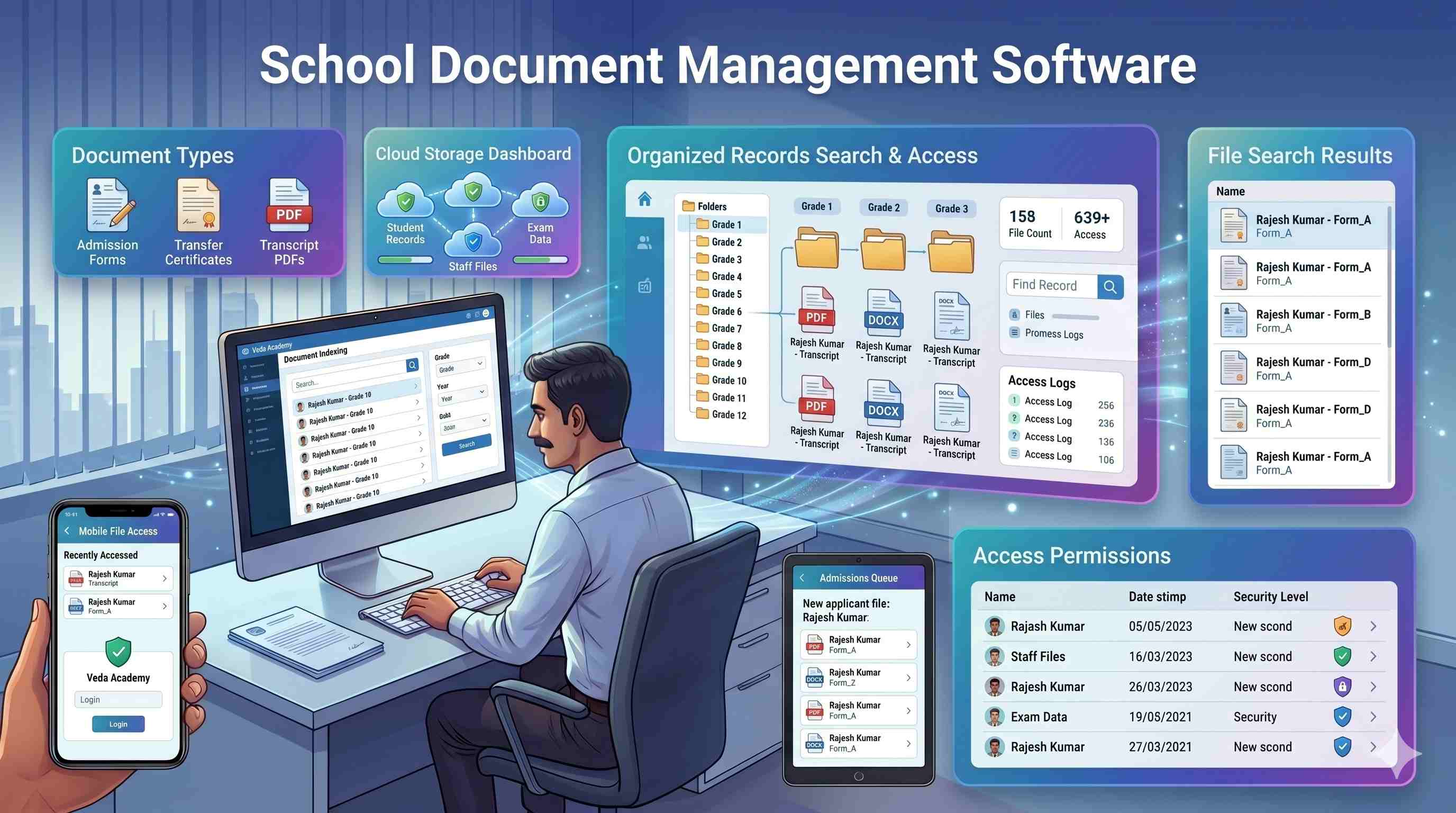
With student records maintained in one system, the admission and withdrawal register is a report rather than a reconstruction, and enrolment is one number rather than four. Attendance captured daily produces per-student, month-wise records on demand, which is what the 75% rule requires you to defend. Fee records, receipts and collection summaries come out of the system your office already uses rather than a parallel spreadsheet. Staff records, qualifications and service details sit against each profile. And document storage against the relevant student, staff member or institutional category means a certificate is retrievable by search rather than by remembering which cupboard it is in — with expiry alerts, which is the specific thing that prevents the stale-certificate finding.
To be precise about our own position: Campus 24x7 stores documents with metadata tagging, role-based access and expiry alerts, and documents are uploaded via scanner or mobile camera and tagged manually — OCR and auto-categorisation are not live today. We generate UDISE+ exports and the attendance, enrolment and fee reports described above. We do not file your affiliation application, and no ERP does.
If you are consolidating records from spreadsheets and registers in preparation for a renewal cycle, the practical sequence is in our guide to school ERP data migration, and the broader board-specific requirements are covered in school ERP software for CBSE schools.
Frequently Asked Questions
How long is CBSE affiliation valid?
Initial affiliation is granted for three years under clause 2.7 of the Affiliation Bye-Laws 2018. Extension is applied for within the time frame set in Appendix-VI. Start the renewal file well before the window opens, because certificates that need reissuing from government departments are the long pole.
Is a fire extinguisher installation letter enough for the fire safety requirement?
No. The fire safety certificate must be issued by the government fire safety department. A letter about installing or possessing fire safety equipment or extinguishers is explicitly not treated as a fire safety certificate. This is one of the most common rejection reasons, and it is entirely avoidable.
Do we still need state recognition if we are applying to CBSE?
Yes. The Recognition Certificate from the State Education Department is required under clause 2.3.4 and that requirement has not been removed. The position on the separate state NOC has been amended by circular, so confirm the current requirement on the SARAS portal before you assemble the file.
What records does CBSE expect us to maintain between inspections?
Clause 14.19 names them: the admission and withdrawal register, attendance records, question papers retained until end-September of the following session, staff service records, fee and financial records, and OASIS and UDISE+ returns. Transfer certificates are covered at clause 7.4, and clause 14.5 requires the annual report on the website before 15 September each year.
What has to go on our school website?
Clause 2.4.9 requires affiliation status, infrastructure, teacher qualifications, student numbers, contact details, copies of transfer certificates issued, and fee information, plus anything the Board directs subsequently. The January 2026 Mandatory Public Disclosure requirement widened this considerably. Pull the current circular from SARAS — the field list is longer than most schools' websites currently carry.
Can a school ERP generate our affiliation documents?
It can generate the records and reports that affiliation and inspection draw on — enrolment extracts, attendance registers, fee records, staff details, UDISE+ exports — and store your institutional certificates with expiry alerts. It cannot produce government certificates, the DEO certificate, the affidavit or the land documents. Any vendor claiming to automate affiliation itself is overstating what software does.
How far in advance should we start preparing?
For renewal, work backwards from the Appendix-VI window and allow 90 days for anything requiring a government department to issue or reissue a certificate. For the continuous records under clause 14.19, the honest answer is that preparation is not an event — a school that maintains them properly has no preparation to do.
Clause references are to the CBSE Affiliation Bye-Laws 2018 (notified 18/10/2018). The Bye-Laws have been amended by subsequent circulars, including the July 2025 revision to Appendix-V under Chapter 3. Details of the January 2026 Mandatory Public Disclosure requirement are drawn from contemporaneous press reporting rather than the circular text. This post is general guidance and not legal or compliance advice — verify every requirement against the current Bye-Laws and circulars on the official CBSE SARAS portal before acting. Product details describe Campus 24x7 as at the date of this post; see the pricing page for live figures.