School Fee Receipt Format in India: What a Valid Receipt Must Contain
A fee receipt is the smallest document a school produces and the one it is most often asked to defend.
A parent needs it for a tax claim or a reimbursement from an employer. Your auditor needs the series to be unbroken. A management committee needs collections to reconcile. And when a parent insists they paid in August, the receipt — or its absence — is the entire argument.
Most schools' receipts are fine until one of those four moments arrives. This post covers what a receipt should contain, a format you can copy, the numbering rules that matter more than the layout, and the GST question that comes up constantly and is usually answered wrongly.
What a School Fee Receipt Must Contain
There is no single statutory format prescribed for school fee receipts the way there is for a GST tax invoice. What governs them is a combination of your own accounting requirements, your auditor's expectations, state fee-regulation rules where they apply, and plain evidentiary sense.
In practice a receipt that survives all four tests carries these fields.
School identification
- School name, exactly as registered — not a shortened or informal version
- Full address, with PIN code
- Affiliation number and school code, for board-affiliated schools
- Contact number and email
- Logo, which matters less legally but matters for a parent submitting to an employer
Receipt identification
- Receipt number — sequential, unique, never reused (see the section below, which is the important one)
- Receipt date — the date the receipt is issued
- Payment date — the date the money was actually received, which is not always the same day
That last distinction catches schools out. A cheque received on the 3rd and cleared on the 9th, or an online payment made at 11pm on the 31st and settled on the 1st, needs both dates recorded or your month-end collection figure will not match your bank.
Student identification
- Student name, in full
- Admission number — the stable identifier; names repeat, admission numbers do not
- Class and section
- Academic year or session
- Father's or guardian's name, useful where sibling names are similar
- Roll number, optional but helpful
Payment detail
This is where most receipts are too thin. A receipt saying "Fees paid — ₹8,500" is nearly useless six months later.
- Head-wise breakup — tuition, transport, activity, examination, library, laboratory, admission, each on its own line
- Period covered — the month, term or quarter each head relates to
- Amount against each head
- Concession or discount shown as its own line, not silently netted off
- Late fine, separately
- Total paid, in figures
- Amount in words, which remains standard practice and prevents figure tampering
- Previous balance and balance remaining, if any
Head-wise breakup is not decoration. A parent claiming a deduction needs tuition separated from transport, because they are not treated the same way. A school that bundles everything into one line forces every such parent back to the office.
Payment mode
- Mode — cash, cheque, DD, UPI, card, net banking, bank transfer or wallet adjustment
- Instrument details — cheque or DD number and bank name, or the UPI/gateway transaction ID
- Transaction reference for online payments, which is what lets you trace a disputed payment
Authentication
- School seal or stamp
- Signature of the authorised signatory, or a system-generated note where the receipt is digital
- For system-generated receipts, a line such as "This is a computer-generated receipt and does not require a signature" is standard and acceptable
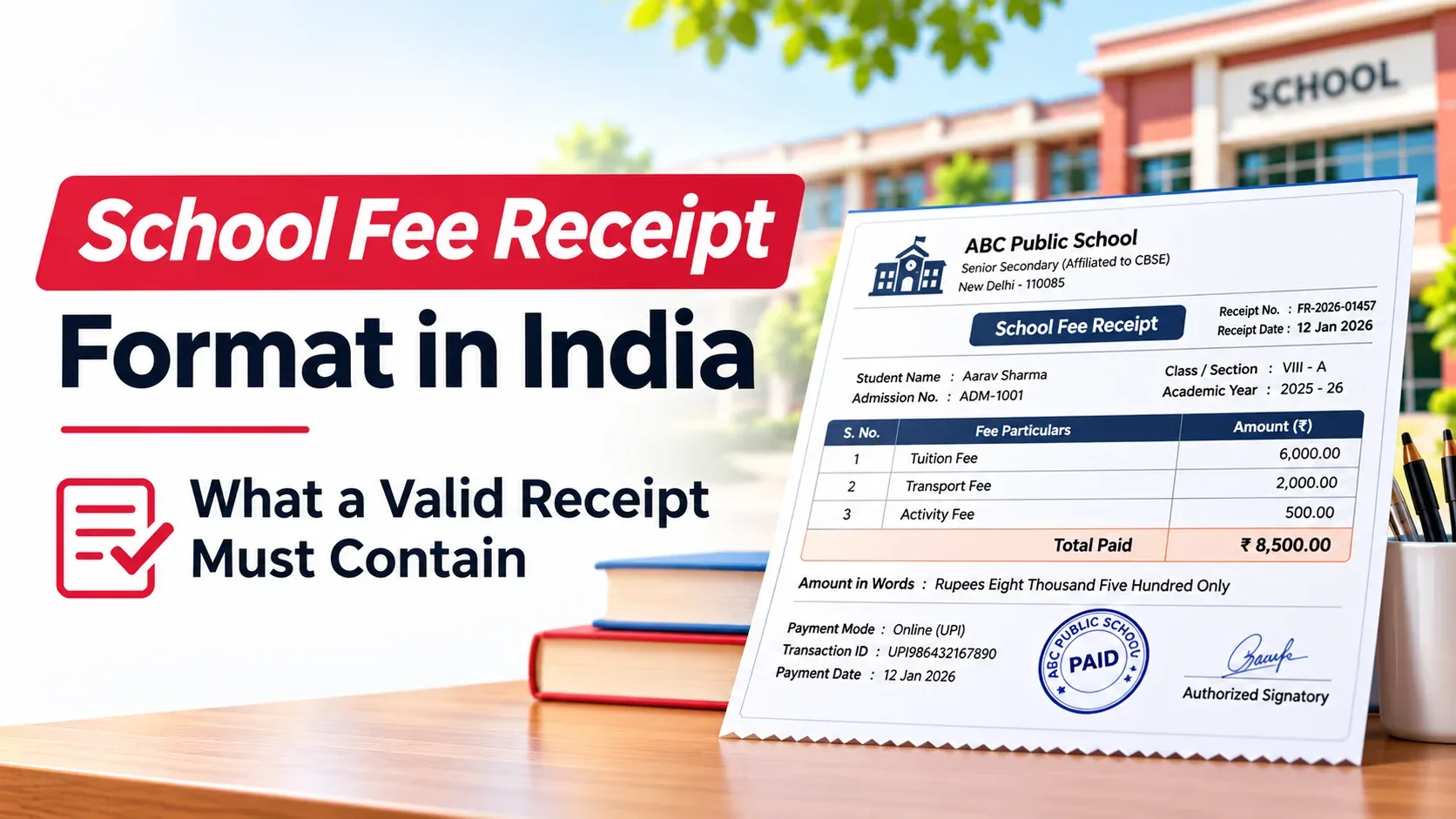
A Sample Fee Receipt Format
A layout you can copy:
┌──────────────────────────────────────────────────────────────┐
│  [LOGO]   SPRINGFIELD PUBLIC SCHOOL                          │
│           Senior Secondary · Affiliated to CBSE              │
│           Affiliation No. 1234567 · School Code: 12345       │
│           12 Example Road, New Delhi – 110085                │
│           Ph: 011-XXXXXXXX · office@example.edu.in           │
├──────────────────────────────────────────────────────────────┤
│                      FEE RECEIPT                             │
│  Receipt No. : FR-2026-01457      Receipt Date : 12-01-2026  │
├──────────────────────────────────────────────────────────────┤
│  Student Name   : Aarav Sharma    Class/Section : VIII-A     │
│  Admission No.  : ADM-1001        Academic Year : 2025-26    │
│  Father's Name  : [Guardian]      Roll No.      : 14         │
├──────────────────────────────────────────────────────────────┤
│  S.No  Fee Particulars          Period        Amount (₹)     │
│  ────────────────────────────────────────────────────────    │
│   1    Tuition Fee              Jan 2026        6,000.00     │
│   2    Transport Fee            Jan 2026        2,000.00     │
│   3    Activity Fee             Jan 2026          500.00     │
│  ────────────────────────────────────────────────────────    │
│        Gross Amount                             8,500.00     │
│        Less: Sibling Concession                  (500.00)    │
│        Add: Late Fine                              0.00      │
│  ────────────────────────────────────────────────────────    │
│        TOTAL PAID                             ₹ 8,000.00     │
│                                                              │
│  Amount in Words : Rupees Eight Thousand Only                │
│  Previous Balance: ₹ 0.00    Balance Due : ₹ 0.00            │
├──────────────────────────────────────────────────────────────┤
│  Payment Mode : Online (UPI)                                 │
│  Transaction ID : UPI986432167890                            │
│  Payment Date : 12-01-2026                                   │
├──────────────────────────────────────────────────────────────┤
│  [SEAL]                            Authorised Signatory      │
│  This is a computer-generated receipt.                       │
└──────────────────────────────────────────────────────────────┘
Adapt the heads to your own fee structure — the structure of the document is what matters, not the specific heads.
Receipt Numbering: The Part That Actually Matters
If you change one thing after reading this post, change how your receipts are numbered.
The rule: sequential, unique, unbroken, and never reused.
An auditor's first test on fee collection is whether the receipt series is continuous. A gap invites the question what happened to receipt 1457? — and "the clerk made a mistake and tore it up" is an answer that leads to more questions, not fewer. The series is the control. Break it and you have removed the only mechanism that proves collections are complete.
A practical numbering scheme:
FR-2026-01457
│   │     └── sequential counter, zero-padded
│   └──────── academic year
└──────────── prefix (FR = Fee Receipt)
Restart the counter at the start of each academic year, not the financial year, unless your accountant prefers otherwise — but be consistent, because a series that changes basis mid-stream is worse than either option.
On cancellations. A wrong receipt is never deleted and never torn up. It is voided — the number stays in the series, marked cancelled, with a reason recorded and the correcting receipt issued with a fresh number. The audit trail is the point: what the record shows is not just the final state, but what happened and when.
This is also why manual receipt books cause trouble when several counters operate at once. Two books running in parallel produce two sequences, and reconciling them at year end is a job nobody wants. One series per school, issued from one system, is the only arrangement that stays clean.
On duplicates. Parents lose receipts constantly. A reissued copy should be clearly marked DUPLICATE and carry the original receipt number and date — not a new number. Issuing a fresh number for a reprint inflates your collection figures and breaks reconciliation.
GST on School Fees: The Short Answer
This question comes up at every fee cycle, so here is the position, with an honest note on sourcing.
Tuition and core fees charged by a school to its own students are exempt from GST. The exemption sits in Notification No. 12/2017-Central Tax (Rate) dated 28 June 2017, as amended — the entry covering services supplied by an educational institution to its students, faculty and staff. It is widely cited as entry 66 of that notification; I was unable to open the official notification text to confirm the serial number directly, so treat the number as commonly-cited rather than verified here. The exemption itself is not in doubt.
"Educational institution" for this purpose covers pre-school through higher secondary, including institutions offering Indian or international syllabi, and institutions whose qualification is recognised by law.
What this means in practice:
- Services a school supplies to its own students — tuition, examination, library, sports, hostel, catering — fall within the exemption
- Where ancillary items are naturally bundled with education, they follow the principal supply
- Services supplied to students of another institution do not qualify
- Third-party activities delivered directly to students by an outside vendor are outside the exemption even where the school collects the money and passes it on
- Private coaching institutions are not educational institutions for this entry, because they do not grant a recognised qualification — this is why a coaching centre's billing looks different from a school's
- Inputs into the school are a separate question: transport, catering, security, housekeeping and examination services supplied to a pre-school-to-higher-secondary institution have their own exemption entry, but things like renting a school bus, or transport-management services as distinct from transport itself, are treated differently
What this means for your receipt: a school issuing only exempt supplies does not put a GST amount on a fee receipt, and does not need a GSTIN line on it. If your school has a GSTIN for some other reason, a fee receipt for exempt education services still should not show tax.
Two caveats, stated plainly. First, the official CBIC servers blocked automated access while I was checking this, so the detail above rests on tax-advisory sources that reproduce the notification rather than on the notification text itself, and the main one is dated 2021. The notification has been amended since. Second, GST treatment of specific heads — a canteen run by an outside contractor, a transport service billed by a third party, premises rented to a bank — turns on facts that vary school to school.
Confirm your own position with your Chartered Accountant before changing how you bill anything. This section is orientation, not tax advice, and the cost of getting it wrong falls on the school.
Digital Receipts: What Changes and What Does Not
A PDF receipt delivered to a parent's phone is as valid as a carbon copy from a book, provided the fundamentals hold: unique sequential number, complete detail, and a record the school can reproduce on demand.
What digital issuance changes:
The duplicate problem mostly disappears. A parent who has the receipt in their messages does not come to the office for a copy.
Reconciliation becomes continuous rather than monthly. Each payment is recorded against a student when it happens, so the collection figure is current rather than assembled at month end.
The signature question resolves. A system-generated receipt carries the computer-generated note instead of a wet signature, which is standard practice and accepted.
What digital issuance does not change: the numbering discipline, the head-wise breakup, the need to void rather than delete, or your obligation to produce the record years later. A digital system that lets a user delete a receipt row is worse than a paper book, not better.
Common Mistakes
One line saying "School Fees". No head-wise breakup, so every parent needing tuition separated comes back to the office.
Two or three parallel receipt books. One per counter, one for transport, one for the pre-primary wing — three sequences, no single source of truth.
Deleting a wrong entry. The gap in the series is the problem, not the error.
Reissuing a duplicate with a new number. Inflates collections and breaks reconciliation.
No transaction reference for online payments. When a parent disputes a payment, the gateway reference is the only way to trace it.
Receipt date and payment date treated as identical. Cheques and late-night online payments land in the wrong month.
No concession line. A concession netted off silently makes the receipt disagree with the fee structure, and the parent cannot see what they were given.
Manually typed receipt numbers. Sooner or later someone types 1457 twice.
How Campus 24x7 Handles Fee Receipts
Each payment produces a numbered receipt that can be printed or saved as a PDF. Receipt numbers are sequential per academic year, generated by the system rather than typed, so the series cannot be duplicated or skipped by hand.
A wrong entry is voided or refunded, never deleted — the record of what happened stays intact, which is precisely what an auditor is testing for. Receipts can be searched and filtered by payment mode.
Collection at the counter works from one screen: search the student by name, roll number or ID, tick the dues being paid, choose the mode and date, add a remark, and print the receipt. Any wallet credit is adjusted automatically, and advance payments for future months are taken from the same screen. Parents can also pay online by UPI, card or net banking through Razorpay, PhonePe or Cashfree, and those payments land in the same ledger with a numbered receipt — so counter and online collections produce one set of books, not two.
If WhatsApp is connected, the parent receives the fee receipt message as soon as the payment is recorded, through the official WhatsApp Business API using your school's own number and Meta-approved templates. That single automation removes most "please send me the receipt again" calls.
For reconciliation, the fee collection report takes a date range and lists every receipt with its number, student, class, payment mode, date and amount — with total collected, receipt count and a breakdown by payment mode at the top, exportable as CSV for your accountant or management committee.
Related reading: school fee collection software covers the counter-and-online workflow in depth, and reducing fee collection delays covers the reminder side.
Frequently Asked Questions
Is there a legally prescribed fee receipt format for schools in India?
No single statutory format is prescribed the way it is for a GST tax invoice. What a receipt must satisfy is your accounting and audit requirements, any state fee-regulation rules that apply to you, and the evidentiary need to prove who paid what, when, and against which head. The field list above covers all three.
Do schools charge GST on fees?
Tuition and core fees supplied by a school to its own students are exempt under Notification No. 12/2017-Central Tax (Rate) dated 28 June 2017, as amended, so a fee receipt for those services shows no GST. Treatment of specific items — third-party vendors, contractor-run canteens, rented premises — varies with the facts. Confirm your position with your CA.
Can a school fee receipt be cancelled?
It should be voided, not deleted. The receipt number stays in the series marked cancelled, with a reason recorded, and a correcting receipt is issued with a new number. Deleting the row creates a gap in the series, and an unexplained gap is exactly what an audit queries.
Should receipt numbers restart each year?
Commonly yes, restarting at the beginning of each academic year with the year in the prefix — for example FR-2026-00001. Financial-year basis is equally defensible. What matters is that you pick one and never change basis mid-series.
What should a duplicate receipt show?
The original receipt number and original date, clearly marked DUPLICATE. Never issue a new number for a reprint — that would count the same payment twice in your collection figures.
Do parents need fee receipts for tax purposes?
Parents commonly need them to claim deductions on tuition fees and for employer reimbursement. This is precisely why head-wise breakup matters: tuition must be distinguishable from transport, activity and other heads on the face of the receipt, or the parent cannot substantiate the claim and will be back at your office asking for a revised copy.
Is a digital or WhatsApp receipt valid?
Yes, provided it carries the same information, a unique sequential number, and the school can reproduce the record on demand. A computer-generated receipt carries a note to that effect instead of a signature, which is standard practice.
The GST discussion above reflects Notification No. 12/2017-Central Tax (Rate) dated 28 June 2017, as amended, drawn from tax-advisory sources reproducing the notification rather than the official notification text, which was not reachable at the time of writing. It is general information and not tax or legal advice — confirm your school's position with a qualified Chartered Accountant before changing how you bill or what your receipts show. Product details describe Campus 24x7 as at the date of this post; see the pricing page for live figures.