CBSE Report Card Format 2026-27: Class 1 to 12, With Grading Scale
Every October and March, an exam coordinator somewhere opens last year's report card template and asks the same question: is this still the right format? This guide answers it class by class, for the people who actually build the cards: exam coordinators, class teachers and principals of CBSE schools.
The short answer: CBSE does not publish one mandatory report card for every class. For Classes 6 to 10, most schools follow the structure from CBSE's 2017 assessment reforms: subject marks out of 100 per term, converted to an 8-point grade scale (A1 to E), with co-scholastic areas and discipline on a 3-point scale (A to C). Classes 1 to 5 use descriptive cards, increasingly NCERT's Holistic Progress Card. Classes 11 and 12 report marks split between theory and practical or internal assessment.
CBSE Report Card Format at a Glance
| Classes | What the card reports | Scholastic grading | Co-scholastic and discipline |
|---|---|---|---|
| 1–2 (foundational) | Descriptive progress, often on NCERT's Holistic Progress Card | Levels or descriptors, usually no marks | Part of the holistic record |
| 3–5 (preparatory) | Descriptive progress, with term marks in many schools | School's own scale, or the 8-point scale | Usually graded A to C |
| 6–8 (middle) | Term 1 and Term 2 marks out of 100 per subject | 8-point scale, A1 to E | 3-point scale, A to C |
| 9–10 (secondary) | 80 marks exam + 20 marks internal assessment per subject | 8-point scale, A1 to E | 3-point scale, A to C |
| 11–12 (senior secondary) | Theory + practical, project or internal marks per subject | Marks and percentage | Varies by school |
The rest of this post takes each group in turn, with a sample layout you can check your own template against.
The CBSE Grading Scale (A1 to E)
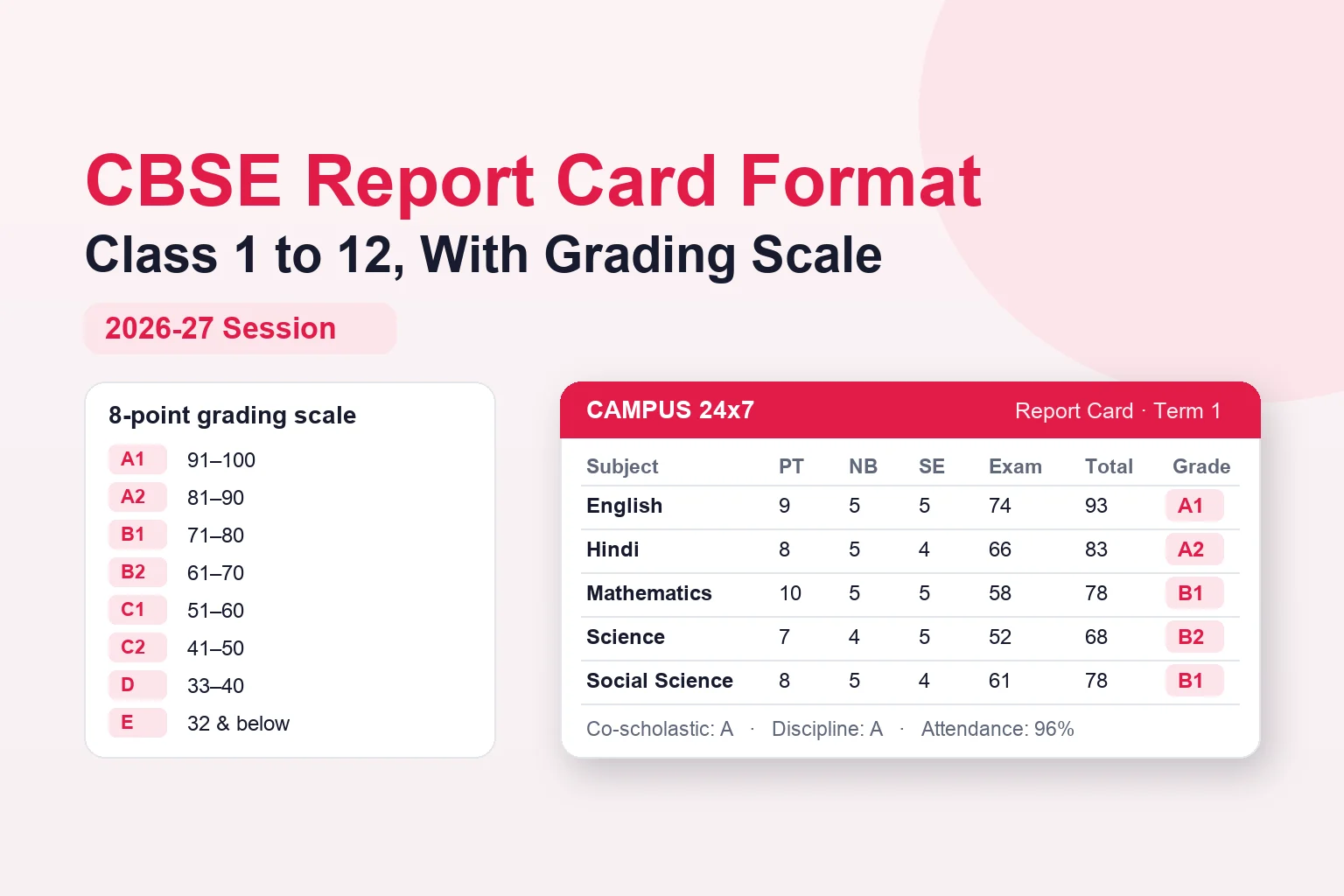
The scholastic scale used for Classes 6 to 10 has eight grades. Grades are worked out from the subject total, not from each component.
| Marks range | Grade |
|---|---|
| 91–100 | A1 |
| 81–90 | A2 |
| 71–80 | B1 |
| 61–70 | B2 |
| 51–60 | C1 |
| 41–50 | C2 |
| 33–40 | D |
| 32 and below | E (needs improvement) |
Co-scholastic areas (Work Education, Art Education, Health and Physical Education) and discipline use a 3-point scale: A = Outstanding, B = Very Good, C = Fair.
If your template still shows a 9-point scale with E1 and E2, or a CGPA with grade points, it is built on the older CCE scheme that the 2017 reforms replaced. That is the single most common reason a report card format looks "wrong" to parents comparing cards across schools.
Class 1 to 5 Report Card Format
CBSE does not prescribe a marks-based report card for the primary classes. Under NEP 2020, the direction is descriptive, competency-based reporting, and NCERT's assessment body PARAKH has developed Holistic Progress Cards for the foundational (Classes 1–2), preparatory (Classes 3–5) and middle (Classes 6–8) stages.
A holistic card differs from a traditional one in who contributes to it:
- The teacher records observations across domains: language, numeracy, physical development, social-emotional growth and creativity.
- The student completes self-assessment statements ("I can…", "I find it hard to…").
- Classmates give simple peer feedback on group work.
- Parents rate statements about the child at home.
Many CBSE schools still issue a term-wise grade card for Classes 3 to 5 alongside, or instead of, the holistic card. If you do, a typical layout is:
- Student details: name, admission number, class, section, roll number, date of birth, parents' names
- Subject-wise grades for each term, with a short descriptive remark per subject
- Co-scholastic areas graded A to C
- Attendance: working days and days present
- Class teacher's remark, signatures and the date of issue
There is no single official "CBSE report card format class 1 to 5 PDF" to download. The PARAKH templates are the closest thing to an official reference for these classes.
Class 6 to 8 Report Card Format
This is the format most schools ask about, because it is the one with the most moving parts. The structure most CBSE schools follow divides the year into two terms. Each subject is reported out of 100 per term:
| Component | Term 1 | Term 2 |
|---|---|---|
| Periodic test | 10 | 10 |
| Notebook submission | 5 | 5 |
| Subject enrichment activity | 5 | 5 |
| Half-yearly exam / Yearly exam | 80 | 80 |
| Subject total | 100 | 100 |
Some schools replace part of the periodic test weight with a portfolio or "multiple assessment" component. The term total stays at 100, so the grade scale works the same way.
A sample Class 6–8 report card layout:
- Header: school name, CBSE affiliation number, school code, academic session
- Student details: name, admission number, roll number, class and section, date of birth, mother's and father's names
- Scholastic areas: one row per subject, with columns for each component in Term 1 and Term 2, the term total and the grade
- Co-scholastic areas: Work Education, Art Education, Health and Physical Education, graded A to C for each term
- Discipline: graded A to C for each term
- Attendance: total working days and days present for each term
- Remarks: class teacher's remark, plus the promotion status on the final card
- Signatures: class teacher, principal and parent, with the date of issue
NCERT's middle-stage holistic card adds sections such as an "ambition card", where students set goals for the year. Schools that have adopted it usually issue it alongside the marks-based card rather than replacing it.
Class 9 and 10 Report Card Format
For Classes 9 and 10, each main subject carries 80 marks for the written exam and 20 marks for internal assessment. The 20 internal marks are built from periodic tests, notebook or portfolio work and subject enrichment activities. The exact split has changed across circulars (10 + 5 + 5 in some years, four components of 5 in others), so confirm the current year's breakdown against CBSE's academic circulars before you lock your template.
A sample Class 9–10 layout follows the Class 6–8 card, with these changes:
- Scholastic columns show internal assessment (20), the exam (80), the total (100) and the grade for each subject
- Practical subjects show theory and practical separately, with their own maximum marks
- An additional (sixth) subject, if taken, is listed separately
- Co-scholastic areas and discipline remain on the A to C scale
The school's Class 10 card covers school exams and internal assessment. The board result itself comes from CBSE. With the Class 10 second-attempt system, internal assessment marks are fixed once and carried forward, so the internal marks you enter are the ones that stand. Two board exams in 2027 covers what that means for the exam office.
Class 11 and 12 Report Card Format
Senior secondary report cards are marks-based. Each subject splits between theory and a practical, project or internal assessment component, commonly 70 + 30 or 80 + 20 depending on the subject's curriculum.
A typical Class 11 or 12 card shows, for each subject:
- Theory marks (out of 70 or 80)
- Practical, project or internal marks (out of 30 or 20)
- Subject total out of 100
- An overall total and percentage, often with the best-of-five calculation the school uses for promotion
Stream matters here. A science section and a commerce section carry different practical structures, so one template rarely fits every section of Class 11.
What Every CBSE Report Card Should Include
Whatever the class, check your template against this list before you print a single card:
- School name, CBSE affiliation number and academic session
- Student name, admission number, roll number, class, section and date of birth
- Parents' names, spelled exactly as in the admission record
- Subject-wise marks with the maximum marks shown
- Grades from the correct scale for that class
- Co-scholastic areas and discipline (Classes 3–10)
- Attendance: working days and days present
- Class teacher's remark and the promotion status on the final card
- Signatures of the class teacher, principal and parent, and the date of issue
Five Mistakes That Force a Reprint
- Mixing old and new grading scales. A template carried over from the CCE years shows CGPA or a 9-point scale while the marks follow the 2017 structure.
- Grading components instead of totals. The grade belongs to the subject total out of 100, not to the 80-mark exam alone.
- Attendance that doesn't match the register. Parents and inspectors notice. If attendance eligibility is a live issue this year, the CBSE 75% attendance rule explains the January checkpoint.
- Wrong maximum marks for practical subjects. One copied column turns a 70-mark theory paper into 80, and every grade in that subject shifts.
- Changing the template mid-year. Term 1 and Term 2 cards that don't match make the year-end comparison impossible.
Making Report Cards in Excel and Word vs a School ERP
A spreadsheet works when one person builds cards for one class. It breaks when 40 teachers send marks in 40 files and someone has to copy each student into a Word template, work out grades by hand and save every card as a PDF.
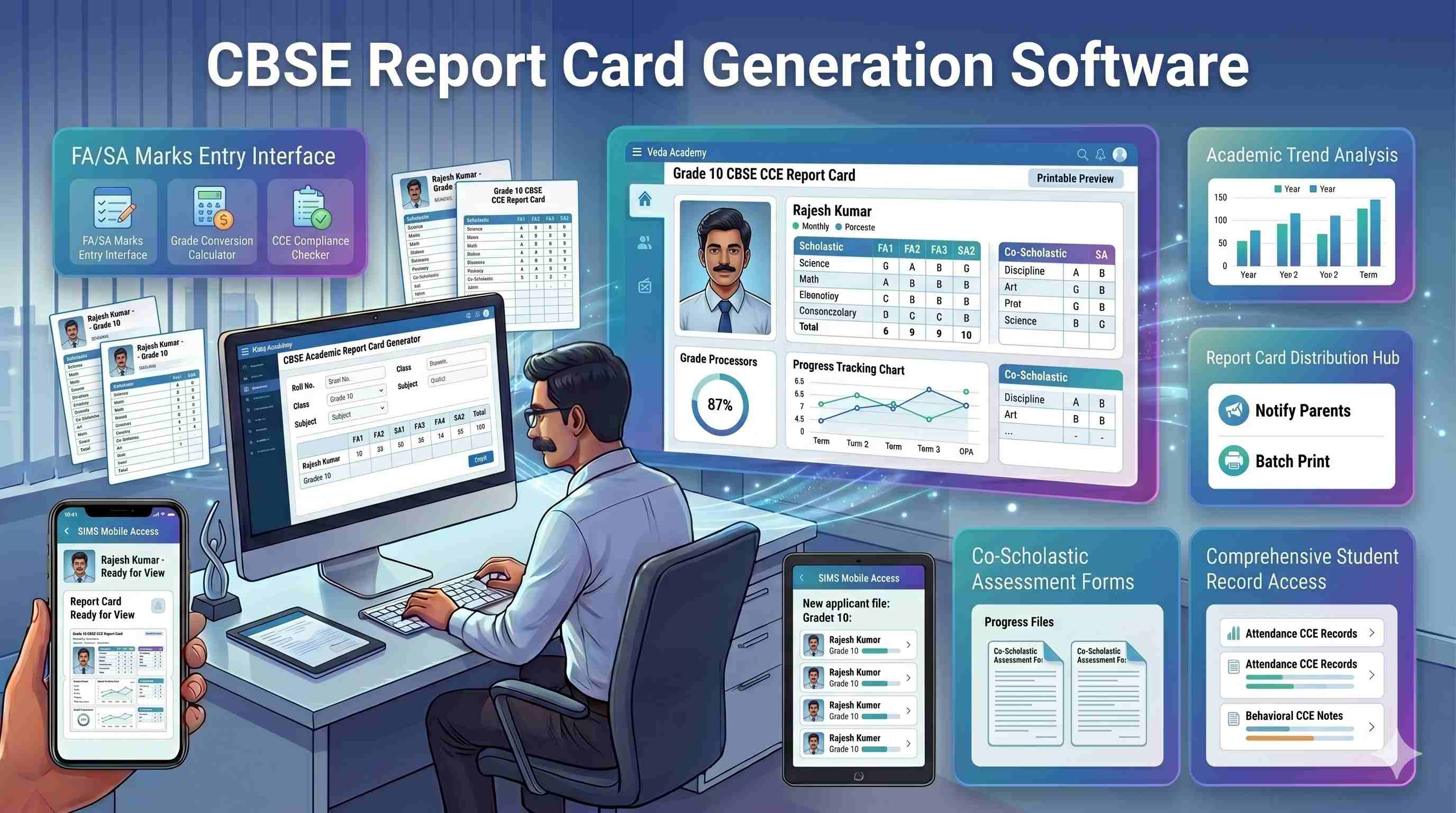
In Campus 24x7's exam management system, you create each term with its weightage and a marks-entry deadline. Teachers enter theory, practical and internal marks for their own subjects. You set the grading bands once, so the eight A1 to E bands above become the school's scale. Computing results builds a result card for every student with subject marks, totals, percentage, grade, section and class rank, and attendance. Cards stay as drafts until you publish them to the parent app, and any card can be downloaded as a PDF.
To be clear about the limits: co-scholastic grades and NCERT's holistic progress card are not part of the result card templates today. If your card depends on them, ask us to walk through your exact template in a demo before you decide. CBSE report card generation software covers the software side in more detail, and every plan starts with two months free.
Frequently Asked Questions
What is the CBSE report card format for Class 6 to 8?
Most CBSE schools report Classes 6 to 8 in two terms. Each subject is out of 100 per term: 10 marks for periodic tests, 5 for notebook submission, 5 for subject enrichment and 80 for the half-yearly or yearly exam. The total is converted to the 8-point grade scale (A1 to E), and co-scholastic areas and discipline are graded A to C.
Is there an official CBSE report card format for Class 1 to 5?
No. CBSE does not prescribe a marks-based report card for the primary classes. NCERT's PARAKH has developed Holistic Progress Cards for the foundational (Classes 1–2) and preparatory (Classes 3–5) stages, which are the closest official reference.
What is the CBSE grading scale for report cards?
A1 (91–100), A2 (81–90), B1 (71–80), B2 (61–70), C1 (51–60), C2 (41–50), D (33–40) and E (32 and below, needs improvement). Co-scholastic areas use A (Outstanding), B (Very Good) and C (Fair).
Does CBSE still use CGPA on report cards?
No. CGPA and the 9-point scale belonged to the CCE scheme, which CBSE replaced with the 8-point scale and a marks-based structure in 2017. A card that still shows CGPA is using an outdated template.
How many marks is internal assessment in Class 9 and 10?
20 marks per subject, with 80 marks for the written exam. The internal marks come from periodic tests, notebook or portfolio work and subject enrichment activities; check the current year's CBSE circular for the exact split.
What is a holistic progress card?
A report card designed under NEP 2020 that records a child's progress across learning, physical, social-emotional and creative domains. It includes self-assessment, peer feedback and parent input alongside the teacher's observations. NCERT's PARAKH has developed versions for Classes 1–2, 3–5 and 6–8.
Assessment structures above reflect CBSE's published framework and common school practice as of the date of this post. Internal assessment splits and formats can change with each session's circulars. Confirm the current year's requirements on cbseacademic.nic.in before you finalise your template.