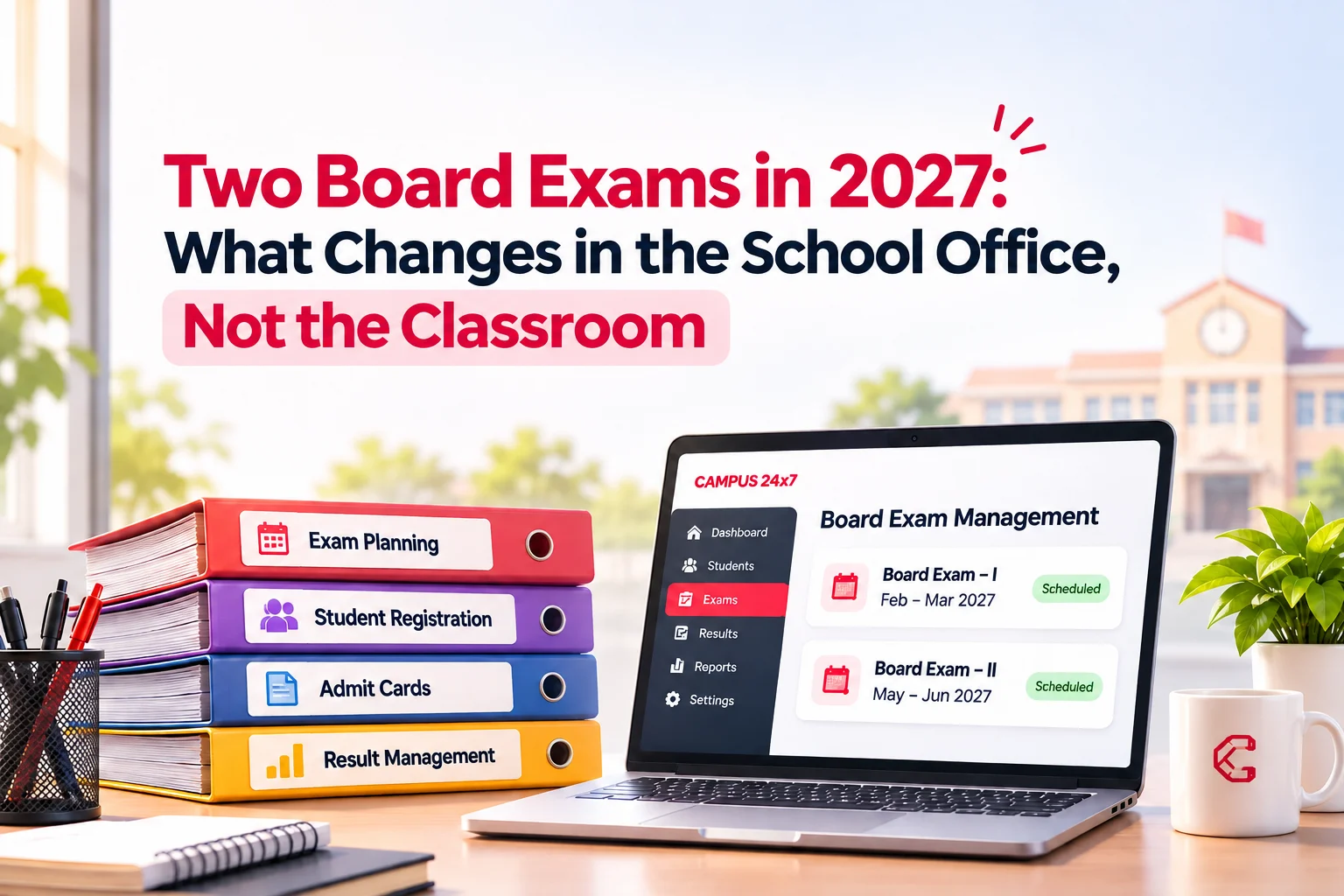
Two Board Exams in 2027: What Changes in the School Office, Not the Classroom
Almost everything written about CBSE's two-attempt system is written for students and parents. Should you take the second exam. Will it hurt your score. What if you fail.
Those are reasonable questions and they are well covered elsewhere. This post is about the part nobody has written for: what the change does to the exam office.
Because for a school, the two-board-exam system is not primarily an academic reform. It is a scheduling and record-keeping change. You now run a second marks cycle, for a subset of students, in a subset of subjects, inside a fixed window, during the weeks when the next session is already starting.
What Is Actually Confirmed, and What Is Not
Worth separating, because a good deal of what is circulating is inference presented as fact.
Confirmed for Class 10. The first examination is mandatory and the second is optional. Both sit in February and May. A student may take the second attempt in up to three subjects. First-exam results come in April, second-exam results in June. A student absent in three or more subjects in the first exam is placed in Essential Repeat and cannot sit the second. Compartment and Improvement exams, previously held in July, move into the May slot.
Confirmed for the current practical cycle. CBSE's circular sets practical and internal assessment for winter-bound schools from 9 November to 19 December 2026, and for regular schools from 1 January to 13 February 2027. Practical, project and internal assessment marks are uploaded alongside the theory marks.
Treat as unsettled. The Class 12 two-attempt position is not settled the way Class 10's is — several outlets describe it as expected rather than notified. Dates reported for the February theory start have appeared in headlines more firmly than in circulars. And the precise rule on which subjects qualify for a second attempt has been reported as applying only to subjects whose external component exceeds 50 marks, which would exclude several. Verify all three against cbse.gov.in and your regional office before you plan around them.
We would rather mark that line clearly than present a tidy table that turns out to be half-guesswork.
The Part That Catches Schools Out: What Carries Forward
Here is the single most important operational fact, and it is the one that gets lost in student-facing coverage.
Internal assessment is conducted once. It is completed before the main examination, and those marks carry forward to the second attempt unchanged. There is no second round of internals, no repeat practical, no opportunity to revise the 20-mark component in May.
Read that again with an administrator's eye, because it has a consequence: the internal and practical marks your teachers are finalising in this window — November to February — are the marks that will sit on a student's result in June 2027. They are not provisional. They are not revisited.
That raises the stakes on a process many schools treat as a formality. If a practical mark is entered against the wrong student in January, the two-attempt system does not give you a second chance to notice. It gives the student a second theory attempt sitting on top of an internal mark that was wrong in both results.
The practical implication is simple and worth acting on now: the verification step before you upload internals matters more this year than last. Not because the rules changed, but because the error now propagates further.
What the May Cycle Actually Adds to the Office
Think of it as a short, compressed exam cycle bolted onto a part of the year that was previously quiet.
A registration window with no slack. CBSE issues the List of Candidates for the second exam after the first results are declared, and schools have reported a 15-day window to verify, update and submit candidate details, with no extensions. That window lands in April, which in most schools is the same fortnight as new-session admissions, section allocation and fee collection. It is not a large task. It is a small task with a hard deadline arriving in your busiest fortnight.
A subset roster you have to construct. You are not managing a class any more. You are managing a list: which students opted in, for which of their three permitted subjects, and whether each is eligible. That list does not exist anywhere until somebody builds it, and it has to be right before the LOC closes.
A second results event. June brings a second set of results for part of a cohort, arriving after your academic year has rolled over. Pass certificates are issued after the second-exam results, and verification and re-evaluation open only at that point, covering both exams.
A counselling load in April. Between the April result and the LOC deadline, families will ask whether to take the second attempt. That conversation needs the student's own marks in front of whoever is having it. A school that can pull a student's subject-wise record in ten seconds has a different April from one that goes looking for a file.
None of this is hard. All of it is new, and it arrives at a point in the calendar that had no exam work in it before.
Setting This Up in a School ERP — Honestly
A fair question at this point is what software does about any of this. Here is the honest answer for Campus 24x7, including where it stops.
The May attempt is just another exam term, and that is the right shape. In our exam management system you create each term with its own name, type, weightage, start and end dates and a marks-entry deadline. A "Second Attempt — May 2027" term sits beside the February one. You are not waiting for a vendor to ship a feature for a policy change; the structure already accommodates it, because a board calling something a second attempt does not make it structurally different from a pre-board.
Per-subject components match how the marks are actually split. Each subject's marks structure decides whether it uses theory, practical and internal, each with its own maximum. That matters here because the splits are not uniform — Class 10 is 80/20 for most subjects, but Computer Applications is 50/50, Home Science 70/30, Painting 30/50/20. If your system only models a single mark per subject, the carried-forward internal has nowhere to live.
Teachers only touch their own classes. A teacher can enter marks only for the classes and subjects they are assigned. In a cycle where a partial cohort is being re-examined, that restriction stops a well-meaning colleague from editing the wrong section.
Drafts until you publish, and reopenable after. Computed result cards stay as drafts until someone publishes them. If a mark needs correcting after publication, reopening the results takes the cards back to draft, hides them from families, and reopens marks entry. Given everything above about internals being final at the board, having an internal correction path on your side is not a luxury.
Where it stops, and you should know before April. Three limits, stated plainly:
- There is no spreadsheet upload for marks. Marks are entered on screen, class by class. For a second attempt covering a handful of students across three subjects, that is a small job. For a full cohort it is real typing, and you should plan the hours rather than discover them.
- Result card PDFs download one at a time. There is no bulk export of a whole class in one action.
- Board-specific report card formats are not built in. There are three templates — traditional, modern and cumulative — and they are layouts, not board-issued formats. Nothing here generates a CBSE-issued mark sheet, and no school ERP should claim to replace what the board itself issues.
That last point deserves emphasis in a post about board exams: your ERP manages your internal record of the cycle. The board's result is the board's. Any vendor blurring that line during a policy change is selling you something they cannot deliver.
A Sequence for the Next Four Months
Written as a calendar, because that is how this problem actually presents.
- Now through February — treat internals as final, because they are. Build a verification step into the practical and internal upload: subject teacher enters, a second person checks the roster against the class list, then it goes. The carried-forward rule means an error here outlives the first exam.
- Before the February exams — create both terms. Set up the February term and a placeholder May term in the same sitting, with their marks-entry deadlines. Doing it once in January is easier than doing it in April under pressure.
- April, the week results land — build the opt-in list immediately. Subject-wise marks for every Class 10 student, in front of whoever is advising families. The 15-day LOC window is the constraint; the counselling is what fills it.
- April — name one person to own the LOC submission. A hard deadline with no extension needs a single owner, not a shared responsibility. This is the one task on this list where being late has no remedy.
- May and June — keep the second-attempt cohort visible after rollover. These students have moved to Class 11 in your records while their Class 10 result is still open. Decide now how you will find them in June, because "they're in the previous session" is how a result goes unrecorded.
- After June — reconcile once. Second-exam results, pass certificates, and any re-evaluation all land after your year has turned over. One scheduled reconciliation beats discovering a gap during the next admission cycle.
The Realistic Summary
For most schools, the two-attempt system will not change teaching much. The syllabus is unchanged, the structure of the exams is unchanged, and the first exam — which every student sits — is the one that already existed.
What changes is administrative, and it is concentrated in two places: a window in winter where internal marks become permanent, and a fortnight in April where a hard deadline lands on top of the new session. Schools that prepare for those two specifically will find the rest routine.
It is also worth saying that this is the first year of the system at this scale, and the sensible posture is to keep your own records tight rather than assume every detail of the process will run smoothly the first time. The school that can answer "what did this student score in which subject, and what did we submit" without a search is the school that comes through it quietly.
If you want to see what a second-attempt term looks like configured against your own subjects and grading bands, we set demos up with your data rather than samples, and the first two months cost nothing. For the mechanics of the ordinary cycle underneath all this, school exam management software and CBSE report card generation cover marks entry and result cards in full. If attendance eligibility is also on your list this term, the CBSE 75% attendance rule post covers the January checkpoint.
Policy details above reflect CBSE's published position for Class 10 as reported at the date of this post, including the circular setting practical and internal assessment windows for 2026-27. The Class 12 two-attempt position and the detailed 2027 date sheet were not settled at the time of writing. Confirm all dates and eligibility rules against cbse.gov.in and your regional office before planning around them. Plan prices and module limits are current at the date of this post; see the pricing page for live figures.