How to Sell School ERP Software to Schools in India: A Practical Guide for Partners
You already know the people who run schools. Maybe you supply their books or uniforms, maintain their computer lab, advise them on CBSE affiliation, or simply grew up with the owner. The question is how to turn that relationship into a school that signs up for software, without becoming a salesperson you would not want to deal with yourself.
This guide is for education consultants, IT vendors, school suppliers, associations and freelancers in India who are thinking about selling school ERP software. It covers who decides, when schools buy, how to open the conversation, the objections you will hear and what you can realistically earn.
The short version: Talk to the principal about a problem they already have (fee dues, absence calls, report cards), let the vendor's team run the demo and setup, and close with the owner or trustee who controls the budget. The best time to start is January to March, when schools plan the next session.
Why Schools Are Buying Now
India has more than 14.7 lakh schools, according to the Ministry of Education's UDISE+ data. A large share of private schools still run on a mix of paper registers, Excel fee sheets and teachers' personal WhatsApp groups.
Three things are pushing them to change:
- Parents expect updates on their phone. An absence alert or a fee receipt on WhatsApp is now ordinary, and parents compare schools on it.
- Fee follow-up eats the office's time. Chasing dues by phone every month is the job most office staff would happily give away.
- Board and NEP 2020 requirements keep adding records. Attendance eligibility, internal assessment marks and holistic progress records all need clean data.
None of this means every school is ready. It means most schools have at least one problem that software solves, and your job is to find it.
Who Actually Decides
In most private schools, three people shape the decision and only one signs.
| Person | What they care about | Your role with them |
|---|---|---|
| Owner, trustee or director | Cost, parent satisfaction, admissions | The person you close with |
| Principal | Daily workload, staff adoption, results | Your champion inside the school |
| Office or accounts head | Fee collection, receipts, registers | Confirms the pain is real |
The common mistake is to pitch the IT teacher or the computer operator. They may love the product, but they rarely control the budget. Start with the principal, who feels the problem every day, and bring in the owner once the principal wants it.
When to Approach a School
School calendars decide whether your call lands or gets ignored. Timing varies by state and board, but for most CBSE and state-board schools that start their session in April:
| Months | What is happening at the school | Approach? |
|---|---|---|
| January–March | Planning and budgeting for the next session | Best window |
| April–May | New session, admissions, fee collection at its peak | Good: the fee pain is visible, but staff are busy |
| May–June (summer break) | Quieter office | Good for demos and setup |
| July–September | Session settled in | Fine for follow-ups |
| October–November | Term 1 exams and report cards | Good: report card pain is fresh |
| February–March | Board exams for Classes 10 and 12 | Avoid the exam office; owners are still reachable |
A school that sees a demo in February and starts during the summer break goes live before the session is in full swing. That is the easiest path for everyone.
Open With a Problem, Not a Product
Nobody wants to hear "Have you heard about our ERP?" Ask about something they already struggle with, then listen. These five questions work because every school has an answer:
- "How do you chase fee dues right now?" Most offices phone parents one by one. Automated WhatsApp reminders for overdue fees and automatic late fines change that.
- "How do parents find out a child was absent?" Usually a teacher calls, or nobody does. An automatic WhatsApp absence alert reaches the parent the same morning.
- "How long did your Term 1 report cards take?" If the answer is "weeks", marks entry by teachers and computed result cards are your opening. Our CBSE report card format guide is a useful thing to send afterwards.
- "Where are your student records if the office computer fails?" Cloud records with role-based access answer a worry most owners have but rarely say out loud.
- "How many WhatsApp groups do your teachers run?" Official school communication through one number replaces dozens of personal groups.
Write down what they say. When you introduce the school to the vendor, that list is what makes the demo relevant instead of generic.
What You Do, and What the Vendor Does
A good partner program should not turn you into an implementation team. In the Campus 24x7 Partner Program, the split looks like this:
| You | Campus 24x7 |
|---|---|
| Register the school in your Partner Console before you approach it | Demo support and product questions |
| Introduce the school and arrange the first meeting | Data migration from registers and Excel |
| Stay in touch with the principal and owner | Staff training and Go-Live |
| Pass on what the school told you it needs | Ongoing support and billing |
Your value is trust and access. Ours is the product and the work of setting it up. Keep it that way and schools get a better experience than if you tried to do both.
Handling the Five Objections You Will Hear
1. "It's too expensive." Bring it down to a per-student figure. The Foundation plan is ₹29,999 a year for up to 500 students, which is about ₹60 per student per year. Every school also gets two months of complimentary access before billing starts, so they see it working before they pay. Point them to the published pricing so there are no surprises later.
2. "Our staff aren't good with computers." This is the most common worry and the most reasonable one. Onboarding includes staff training, and teachers mostly use the mobile app for attendance and marks entry. Suggest starting with one or two modules rather than everything at once.
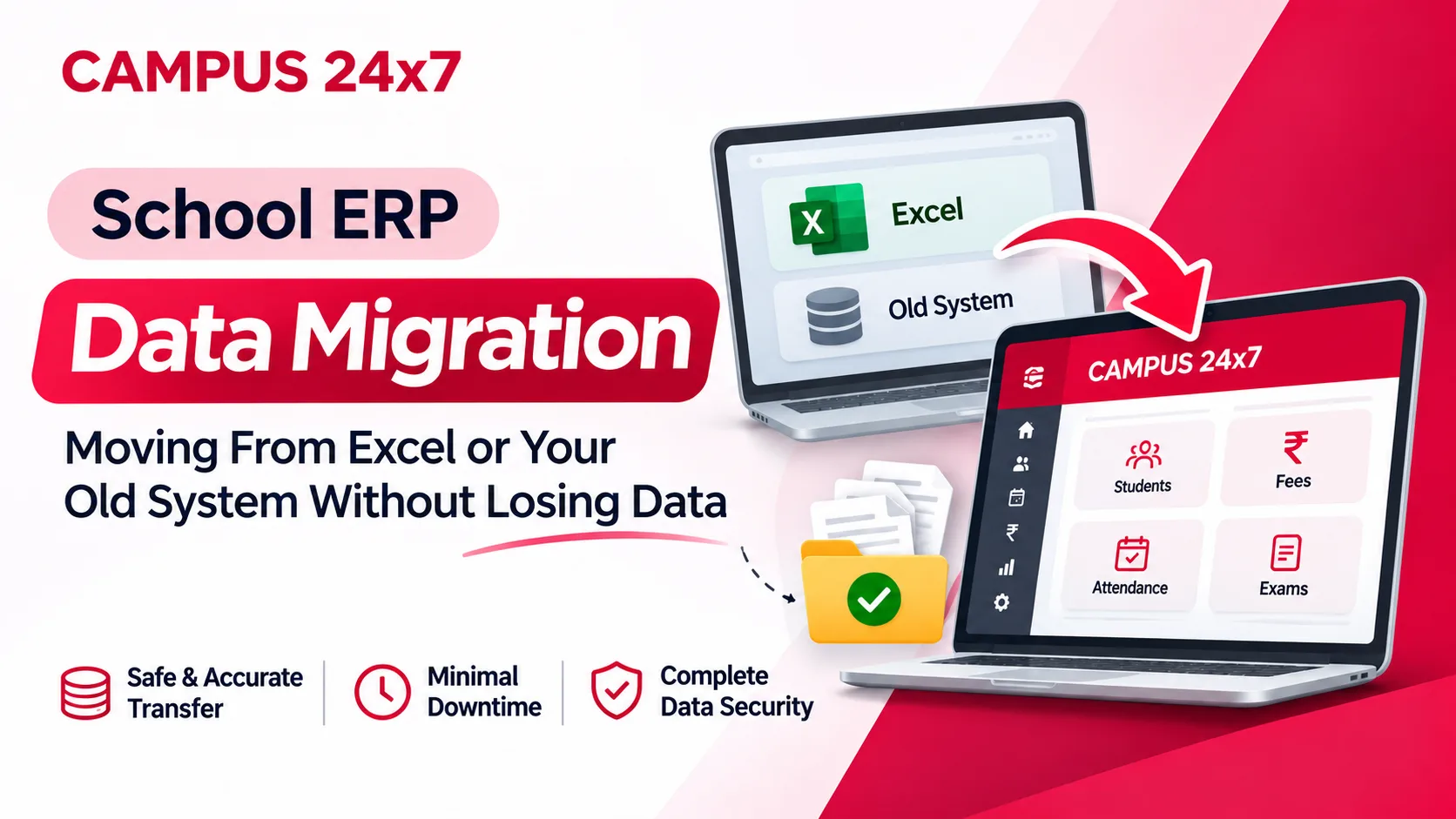
3. "Moving our data will be a nightmare." Data migration is handled by the onboarding team, not by the school's office staff. Ask what they currently use (registers, Excel or another software) so the team knows what to expect.
4. "We already manage with Excel and WhatsApp." Many schools do, until a fee register and a WhatsApp group disagree. School ERP vs Excel lays out the real cost comparison and is worth forwarding.
5. "We tried software before and nobody used it." Take this seriously and ask what went wrong. Usually the answer is too many modules at once with no training. Suggest starting with attendance and fees, the two things every staff member touches, and adding the rest once those are routine.
What Not to Do
These rules protect your commission and your reputation with the school:
- Never promise discounts or extra free months. Schools pay published prices directly to the vendor. Offering something you cannot deliver ends the relationship.
- Never collect money from the school. Not a deposit, not a setup fee, nothing.
- Register before you approach. The first partner to register a school gets the credit. A school that already contacted the vendor through the website or a demo request is not eligible.
- Don't refer the school you work at. Self-referrals, including schools where a close relative is on staff or the management, do not earn commission.
- Don't guess at features. If a school asks whether the software does something and you are not sure, say you will check. The demo team will answer accurately, and a wrong promise costs you more than a pause.
What You Can Earn
In the Campus 24x7 program, you earn 30% of every payment a school makes in its first 12 months of paid subscription while you have 1 to 5 active paying schools, and 40% once you reach 6 or more. Commission reaches your bank within 7 days of each payment.
| Plan (yearly billing) | School pays | You earn at 30% | You earn at 40% |
|---|---|---|---|
| Foundation (up to 500 students) | ₹29,999 | ₹9,000 | ₹12,000 |
| Growth (up to 1,000 students) | ₹49,999 | ₹15,000 | ₹20,000 |
| Scale (up to 2,500 students) | ₹1,09,999 | ₹33,000 | ₹44,000 |
If a school pays monthly instead, you earn on each of its first 12 monthly payments. As an example, bringing 10 Growth plan schools on yearly billing earns ₹1,75,000 in a year: ₹15,000 each on your first 5 schools and ₹20,000 each on the next 5 at the higher rate. Figures are rounded to the nearest rupee and based on current published prices.
A 30-Day Plan for Your First School
Week 1. Apply to the partner program. While your application is reviewed, list 20 schools where you know the principal or owner personally.
Week 2. Once approved, register your five strongest schools in the Partner Console. Call or visit, and ask the five questions above.
Week 3. For every school that named a real problem, arrange a demo. Share what they told you so the demo starts with their problem.
Week 4. Follow up with the owner after the demo. If the timing is wrong, note when their planning window opens and come back then.
Most schools will not decide in 30 days, and that is fine. The goal of the first month is two or three genuine conversations and one school moving toward a trial.
Frequently Asked Questions
Do I need technical knowledge to sell school ERP software?
No. You need relationships with school decision-makers and the ability to ask good questions. Product demos, setup, data migration, training and support are handled by the Campus 24x7 team.
Can an individual become a partner, or only a company?
Both. Individuals, companies and associations or groups can apply. Every application is reviewed and approved by the Campus 24x7 team.
Is there a fee or a sales target?
No. Joining is free and there are no sales targets. You can work part-time alongside your existing business.
When do I get paid?
By bank transfer within 7 days of each payment the school makes to Campus 24x7, for the school's first 12 months of paid subscription. There is no minimum payout.
Can I offer a school a discount to close the deal?
No. Schools are billed directly at published prices, and partners cannot offer discounts or free months or collect any payment. Every school already gets two months of complimentary access.
Commission rates, plan prices and program rules reflect the published Campus 24x7 Partner Program terms at the date of this post. See the partner program page for current terms and the full fair-play rules.